On this page
The readability problem with alien design
An alien creature is supposed to look unfamiliar. In a fast arcade game, unfamiliar is expensive: a player has a fraction of a second to decide whether something is a threat, and unfamiliar shapes take longer to classify than familiar ones.
That is a real tension rather than a stylistic one. The most convincingly alien design we tried during development was also the one playtesters most often failed to react to, because it did not read as a creature at all until it moved.
The compromise the library settled on: alien in surface detail, familiar in silhouette. An unusual palette, unusual textures and unusual proportions are cheap; an unusual outline is not.
What stays constant across every creature
Regardless of type, every creature in the library keeps four things:
- Eyes. Two of them, high on the body, with dark pupils. Eyes are the single fastest signal that something is alive and facing you.
- A clear facing direction. You should be able to tell where it is looking without watching it move.
- A rounded mass. Threats are built from circles and rounded rectangles; scenery is built from straight edges.
- A palette from the house set. Creatures never use background colours, so nothing alive is ever the same colour as anything inert.
Those four constants are why a creature you have never seen is still readable within about a second, which is the standard the whole library is held to.
Where the alien creatures appear
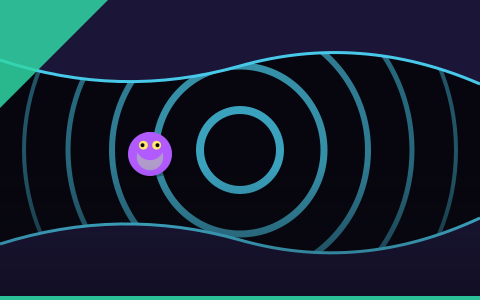
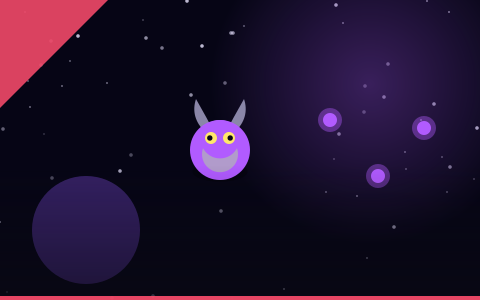
Void Drifter is the main one, and it appears in three roles: as the player character in Gravity Monster, as the player in Monster Tunnel, and as the final boss of Monster Arcade Ultimate.
Using the same creature as both a player character and a boss is deliberate. It reinforces that the creatures on this site are a cast rather than a set of interchangeable enemies, and it means the boss fight has a recognisable silhouette from the first frame.
The visual distinction between the two is scale and palette brightness, not shape — which is exactly the silhouette-first rule applied to the same creature twice.
Alien as a filter option
'Alien Monsters' is one of ten monster types you can filter by on the games page, alongside beasts, giants, dragons, shadow creatures, jungle monsters, sea monsters, robot monsters, fantasy monsters and boss monsters.
The filter exists because creature type genuinely correlates with how a game feels. Alien-type games in this library skew toward space settings and unusual movement rules, which is a real pattern rather than a tagging convenience.
If you want the whole set, the filter on the games page is the fastest route.
Colour does the rest
The other half of making something read as alien is palette, and it is a single rule: use colours that do not occur in the rest of the library.
Everything terrestrial here sits in greens, browns, stone greys and fire oranges. The void scenes use violet, deep indigo and a cyan that appears nowhere else — so a player arriving at one knows they have left, before a single creature has moved.
It is cheap and it works better than detail does. A silhouette in an unfamiliar colour reads as unfamiliar; the same silhouette in a familiar one reads as a variant of something you have already fought.
Movement as characterisation
In a game with no dialogue and no cutscenes, how a creature moves is most of its personality.
Void Drifter does not walk. It drifts, with momentum in every direction and no friction to stop it, which reads as weightless and slightly uncontrollable — and that is the entire characterisation, achieved with a physics constant rather than with art.
It is also why the same creature works as both a player character and a boss. As a player it feels alien to control; as a boss it feels alien to fight. Nothing about the sprite changed.
Designing something that reads as unfamiliar
Making a creature feel alien is mostly about removing cues rather than adding detail.
Terrestrial creatures here have legs, a clear front, and a bilateral silhouette — things that tell you instantly which way they will move. Take those away and you get something a player cannot immediately predict, which is precisely the feeling the category wants.
The constraint is that unpredictable appearance must not mean unpredictable behaviour. A creature that looks unreadable and moves unreadably is not alien, it is unfair. So the void creatures all run the same seven behaviours as everything else — they simply do not announce which one through their shape, which means you learn them by observation rather than by instinct.
That is a slower kind of learning and a fair one, and it is why the void scenes appear later in most players' route through the site rather than at the start.
Sound in the void scenes
The audio in the space and void games is deliberately different from everywhere else on the site, and it is doing work beyond atmosphere.
Effects there are built from higher, thinner tones with longer decays than their terrestrial equivalents. A hit sounds sharper; an ambient drone sits underneath everything. The effect is unfamiliarity, achieved with the same synthesis approach used everywhere.
What stays constant is the information. Telegraph cues, phase-change roars and damage sounds remain clearly distinct from one another and from the ambience, because the atmosphere is not allowed to interfere with the channel.
Key takeaways
- Unfamiliar silhouettes cost classification time, which is expensive in a fast game.
- The library's rule is alien in surface detail, familiar in silhouette.
- Every creature keeps eyes, a clear facing, a rounded mass and a house palette colour.
- Void Drifter appears as both a player character and a boss, which is deliberate rather than reuse.
Frequently asked questions
Why do all your creatures have visible eyes?
Eyes are the fastest signal that something is alive and facing you, which matters more in a fast game than any amount of exotic design.
Which games feature alien creatures?
Gravity Monster, Monster Tunnel and the final stage of Monster Arcade Ultimate. The games page has a monster-type filter for the whole set.
Are any of these based on existing sci-fi designs?
No. Every creature here is original and drawn procedurally in code. We use no characters, artwork or trademarks from any existing property.
Why are the void creatures harder to read?
Are they actually harder, or just unfamiliar?
Why do the void scenes sound different?

Alex Morgan
Browser Games Editor & Interactive Gaming Content Specialist
Alex Morgan is the editorial byline for everything published on Monster Arcade — the design notes behind all 30 original games, the strategy guides, and the tuning decisions that set every difficulty curve on the site. More about our editorial byline.
Published · Last updated
Games mentioned in this guide

Gravity Monster
Flip gravity to walk on the ceiling. Twelve chambers where the safest floor is usually above you.
Monster Tunnel
Thread a narrowing tunnel with two inputs. The smoothest difficulty curve on the site.
Monster Arcade Ultimate
The flagship. Three stages in one run — a runner, a collection stage and a boss fight.