On this page
One behaviour, one tell, one counter
Every creature in the library is designed to the same specification, and it fits in a sentence: one movement behaviour, one telegraph, one counter.
A gorer chases, crouches before charging, and is countered by stepping sideways. A spitter holds distance, glows before firing, and is countered by walking around the glob. Nothing has two behaviours, because a creature with two is a creature a player cannot predict — and unpredictability is not the same as difficulty.
The payoff is that the whole roster can be learned in a few minutes and then applies across thirty games.
Telegraphs freeze the creature
The most important implementation detail: a creature with a telegraph stops moving while the telegraph runs.
Two reasons. First, it is an additional tell — something that was approaching and suddenly stops is signalling an attack even if you did not consciously register the visual cue. Second, it makes the creature's position perfectly predictable for the duration, which turns the wind-up into the best moment to reposition.
It also prevents an unfair combination: a creature that could move and telegraph simultaneously could close distance during its own wind-up, which would make the telegraph length meaningless.
The overshoot
Charging creatures do not stop at your position — they charge through it and overshoot, then spend a recovery window facing the wrong way.
That is deliberate and it does two jobs. It creates the free damage window that rewards correct dodging, and it makes 'step sideways' the correct response rather than 'back away'. Backing away keeps you on the charge line; stepping sideways hands you the creature's back.
A charge that stopped precisely at the player would be a homing attack with extra steps, and there would be no correct dodge at all.
Keeping a roster readable as it grows
- One distinguishing feature each. Horns, spines, wings, or a tail — one, not four. Multiple features produce visual mush at speed.
- Colour maps to role. Lime and pale green for common creatures, orange for chargers, violet for ranged, dark green for heavies.
- Size maps to threat. Bigger means slower and tougher, without exception. A small fast heavy would be unreadable.
- Never a scenery colour. Nothing alive shares a colour with anything inert.
- Always animated. A static creature reads as scenery; a breathing one reads as a threat.
Introduction schedules
New creature types are introduced on a schedule rather than randomly, in every game with more than one type.
In Monster Arena: crawlers immediately, snappers from round two, gorers from round four, spitters from round seven, brutes from round nine. Endless games run the same schedule against elapsed time.
The purpose is that a player always meets a creature alone before meeting it in a crowd. Meeting a brute in your first ten seconds teaches you nothing, because you have no context for what makes it different from anything else.
The enemy we cut
A worked example of the one-behaviour rule, from getting it wrong.
An early creature design chased you, and periodically stopped to fire a projectile, and fled when damaged. Three behaviours, each individually sensible.
It was unreadable. Playtesters could not predict it, and because they could not predict it they could not counter it — so it did not feel difficult, it felt arbitrary. Nobody described it as hard; several people described it as buggy.
It became two creatures: a chaser and a keep-away shooter. Both are individually easier and the pair is more interesting to fight, because you can tell which problem you are solving.
Silhouette first
A creature has to be identifiable at speed, small, and partially occluded. That means the silhouette carries almost all of the communication and the details carry almost none.
The working test is whether a creature is recognisable as a solid black shape at a quarter size. If two creatures fail that test against each other, they are the same creature wearing different colours, and a player will eventually respond to one as though it were the other.
The properties that do the work are overall proportion, the number and direction of protrusions, and the ratio of body to limbs. Something wide and low with short protrusions reads as heavy; something tall and thin with long ones reads as fast.
Colour is a secondary channel and must never be the only one. Roughly one person in twelve with typical male colour vision will not distinguish a red creature from a green one reliably, and a design that relies on that difference has excluded them from reading the game.
Making a creature feel fair
Four properties separate an enemy players enjoy fighting from one they resent, and none of them is about difficulty.
It announces itself. Any attack that can hurt you telegraphs first, every time, with no exceptions for difficulty.
It is beatable by one clear response. If a player does the right thing, they are safe. A creature where correct play still sometimes fails teaches nothing.
It behaves the same everywhere. The same creature in a different game does the same thing, so knowledge transfers.
It is visible before it is dangerous. Nothing spawns inside your position or arrives from off-screen already attacking.
Key takeaways
- Every creature has one behaviour, one telegraph and one counter — two behaviours makes a creature unpredictable rather than hard.
- Telegraphs freeze the creature, which is both an extra tell and a guarantee it cannot close distance during its own wind-up.
- Chargers overshoot to create a punish window and to make sideways the correct dodge.
- One distinguishing feature per creature; colour maps to role and size maps to threat.
Frequently asked questions
Why do creatures stop before they attack?
The telegraph freezes them. It is an extra tell and it prevents a creature closing distance during its own wind-up.
Why do chargers run past me?
The overshoot is deliberate. It creates a punish window and makes stepping sideways the correct dodge rather than backing away.
How do you stop a large roster becoming confusing?
One distinguishing feature each, colour mapped to role, size mapped to threat, and no creature sharing a colour with scenery.
What makes a creature readable at speed?
How many behaviours should one creature have?
Should a harder enemy telegraph less?
How many enemy types does a game need?

Alex Morgan
Browser Games Editor & Interactive Gaming Content Specialist
Alex Morgan is the editorial byline for everything published on Monster Arcade — the design notes behind all 30 original games, the strategy guides, and the tuning decisions that set every difficulty curve on the site. More about our editorial byline.
Published · Last updated
Games mentioned in this guide
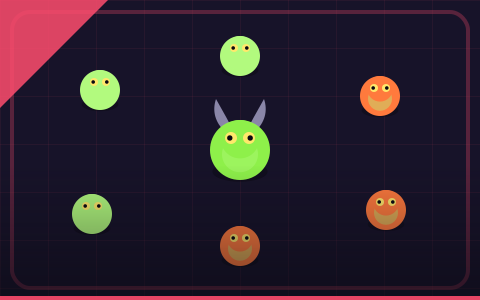
Monster Arena
Clear each round of creatures, then pick one of three permanent upgrades. Builds compound fast.
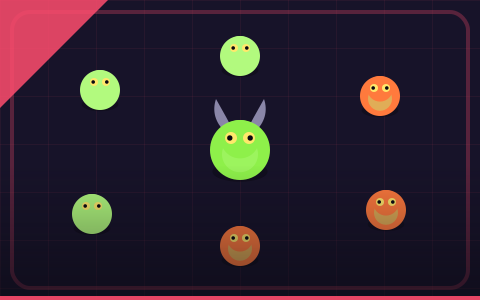
Ultimate Monster Challenge
The hardest game here. Endless waves punctuated by a boss every fifth round, in a shrinking arena.

Monster Cave Quest
Explore a branching cave for twelve treasures, then find the way out before your lantern dies.