On this page
What an arcade adventure game actually is
The word 'adventure' carries a lot of baggage from long story-driven games. Here it means something much more specific: a game with spatial freedom and an objective. You are not being pushed forward by a scrolling camera and you are not pinned to an arena. You can go left, and sometimes going left is correct.
That freedom creates the category's characteristic decision, which is present in all five games here: the shortest route and the safest route are almost never the same one.
Monster Cave Quest hides its treasure down dead-end branches. Monster Escape gives you a locked exit and scatters the keys one per quadrant. Underwater Monster Quest adds an oxygen meter, so every detour spends a resource you can watch draining.
Routing, not reflexes
The skill that separates a good adventure run from a bad one is route memory. On your first attempt you are exploring; by your third you should be executing. That progression is the entire point of the category, and it is why these games reward replay differently from an endless runner — you are not getting faster, you are getting better informed.
A practical technique that helps almost everybody: on a failed run, spend ten seconds before restarting recalling the order you visited rooms in, not the layout. Order is what you actually control. Most players who plateau in Monster Cave Quest are collecting the right items in the wrong sequence and walking the same corridor four times.
- Clear dead ends before you take the route that opens the exit, not after.
- Pick up an item on the way past something, never as a dedicated trip.
- If two branches look equally rewarding, take the one nearer your escape route first.
- Treat a corridor you have already cleared as a safe lane and use it to reposition.
The resource that makes routing a trade
A map with no cost attached is a maze, not an adventure. Every game in this category attaches something that drains:
| Game | The resource | What it does to your decisions |
|---|---|---|
| Monster Cave Quest | Lantern oil | Shrinks your visible radius — you lose information before you lose the run |
| Underwater Monster Quest | Breath | Drains twice as fast below the mid-reef line, so depth is a real cost |
| Monster Escape | Hound pressure | More hounds spawn over time, so the safe space shrinks rather than a clock running |
| Pixel Monster Adventure | The woken guardian | Nothing drains until you take the crown — then everything does |
| Gravity Monster | Nothing | A pure puzzle; failing a chamber costs seconds, so experimenting is correct |
The lantern in Monster Cave Quest is the most instructive of these, because it removes information gradually rather than ending the run suddenly. Three-quarters of the way through, your visible radius is small enough that unexplored branches become genuinely risky — which is precisely when you should stop exploring them.
Banking beats greed
Two of these games make you carry your haul until you reach a safe point. In Monster Cave Quest you bank at the cave mouth; in Underwater Monster Quest you bank at the surface. Until then, everything you are carrying is at risk.
The maths is unambiguous and most players ignore it anyway: leaving with eight treasures beats losing everything while chasing the twelfth. A completed run with a partial haul always outscores a failed run with a perfect one, because a failed run scores zero.
Monster Cave Quest has three treasures placed in what we internally call the greed pocket — a chamber cluster far from the exit holding the highest values in the game. Taking all three is possible on a fast, confident run and is a reliable way to lose everything on a slow one. Knowing whether you have time is the highest-level skill the game asks for, and it comes from route memory rather than reflexes.
How the creatures behave
Enemies in adventure games are obstacles with rules rather than threats that hunt you relentlessly. Most patrol a fixed path, some drift on a sine wave, and a small number chase but only within a limited radius.
This is deliberate. A relentless chaser turns an exploration game into a running game, which is what the runner category is for. Here, a creature is a moving wall you have to time, which keeps the emphasis on where you go rather than how fast you can flee.
The two exceptions, and why they exist
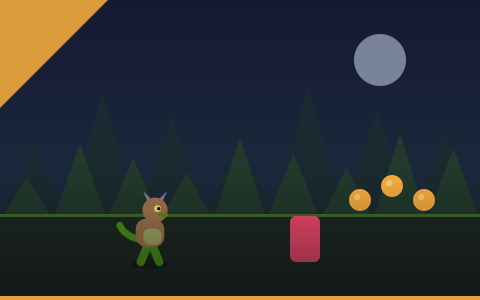
Monster Escape uses line-of-sight pursuit: Wisp Hounds spot you down straight corridors and lose interest when you turn a corner. That single rule is what makes the game playable — corners are safety, corridors are risk — and after ninety seconds the hounds stop patrolling and begin converging on your last known position, which changes the game rather than merely intensifying it.
Pixel Monster Adventure has a guardian that wakes only when you take the crown. That single late chase exists to make the last two minutes of a successful run tense, and it is deliberately the only part of the game you cannot solve by thinking slowly.
Movement is not always walking
Two games change how you move, and both changes are load-bearing rather than decorative.
In Underwater Monster Quest you have momentum in all four directions plus a gentle upward buoyancy, so stopping requires swimming against yourself. Every route has a cost in correction time that a walking game would not have, and tight coral gaps are much harder than their size suggests.
In Gravity Monster you cannot jump at all. Your only vertical control is flipping which way down is, and the flip is instant while the fall is not — so a mid-air double flip hovers you roughly in place. Loose crates obey your gravity too, which turns them from obstacles into tools. Three of the twelve chambers cannot be solved without exploiting that, and the game introduces the idea gently in chamber four before requiring it in chamber seven.
The pleasure of a second run
Adventure games are the only category here where the second run is straightforwardly better than the first, and it is worth saying why that feels good.
On a first attempt you are exploring: every corridor is unknown, every decision is a guess, and the run usually ends untidily. On a second you are executing a plan you built, which converts the same map from a source of anxiety into a thing you know. That shift is the specific reward this category offers and no other category here can.
It also means a failed first run is not wasted, which is unusual. In a runner, a bad run teaches you very little. In an adventure game, a bad run is reconnaissance.
Resource meters and the point of no return
Adventure games are built around a meter that only goes down, and the whole category is a series of decisions about one number.
Lantern oil, oxygen, energy — the name changes and the structure does not. It depletes continuously, it is replenished by items placed sparingly, and when it empties the run ends. That makes every step you take away from an exit a step you are also paying to take back.
The concept worth internalising is the point of no return: the moment at which the remaining meter is exactly enough to reach an exit and no more. Everything before it is a choice; everything after it is a hope.
Most lost adventure runs are lost because the player never calculated that point, and the calculation is not difficult. If it took you forty seconds of meter to get here, it will take about forty to get back, and the useful question at any moment is whether twice your distance from an exit still fits inside what you are holding.
Mapping without a map
None of these games gives you a minimap, and that is deliberate — the mapping is meant to happen in your head, because that is where the satisfaction of a second run comes from.
Three techniques make it manageable:
- Remember junctions, not corridors. A corridor has one property: where it goes. A junction has several and is where you will make mistakes.
- Use the scenery. Every area has visual landmarks that do not repeat — a crystal formation, a broken pillar, an unusual colour. They are placed deliberately for this.
- Fix your direction of travel first. Deciding 'I am going deeper' or 'I am going back' before you move prevents the most common adventure failure, which is oscillating between two areas while the meter drains.
Why there is no save
Adventure games are the category where a save system would be most conventional, and there is none. That is a deliberate decision with a real cost, so it is worth defending.
A save turns an adventure run into a sequence of independent segments, each attempted until cleared. That removes the resource meter's entire meaning — if you can reload, the question 'can I afford this detour' has no weight, because an unaffordable detour is simply retried.
Without saves, the meter is the game. Every decision is made under real uncertainty with a real cost, and completing a run is an achievement rather than an inevitability.
The compensation is length. No adventure game here runs longer than about eight minutes, so a failed run costs you a small amount of time and returns a map you now know. A three-hour game with no saves would be cruel; an eight-minute one is a structure.
Where to start
Monster Cave Quest is the clearest introduction — a readable layout, generous lighting at the start, and a treasure count that tells you exactly how much is left to find.
If you like a puzzle in your movement, Gravity Monster is the most mechanically distinct game on the whole site and the most forgiving to experiment in.
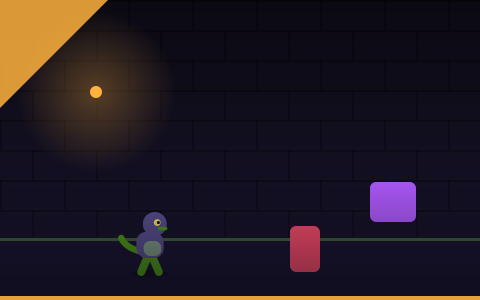
If you want the longest single run, Pixel Monster Adventure has the biggest map, a real ending, and a deliberate absence of any minimap — each wing has its own palette and architectural motif for orientation instead, which makes learning the dungeon part of the game.
Key takeaways
- Adventure games give you spatial freedom plus an objective; the shortest route and the safest route are almost never the same.
- Learn the order you visit rooms in, not the map — order is the part you control.
- Banking a partial haul always beats losing a perfect one, because a failed run scores zero.
- Creatures here patrol rather than hunt, which keeps the focus on routing instead of fleeing.
- Gravity Monster has no resource drain at all, which makes experimenting the correct strategy rather than a luxury.
Frequently asked questions
Are adventure games longer than the other categories?
Yes. A typical run is three to ten minutes against roughly one to two for a runner. They suit a single satisfying session rather than repeated short attempts.
Can I actually complete them?
All five have a real win state, which is unusual on this site — most other categories are endless and scored.
Do I need to memorise the maps?
It helps enormously but is not required. Every layout is readable on sight and the games show you how many collectibles remain. Memory turns a survivable run into an efficient one.
Why does Monster Escape generate a new maze every time?
So the skill is live routing rather than memorisation. It is carved depth-first with extra loops knocked through, because a perfect maze with no loops makes every wrong turn a full retrace.
Is there any way to save progress mid-run?

Alex Morgan
Browser Games Editor & Interactive Gaming Content Specialist
Alex Morgan is the editorial byline for everything published on Monster Arcade — the design notes behind all 30 original games, the strategy guides, and the tuning decisions that set every difficulty curve on the site. More about our editorial byline.
Published · Last updated
Games mentioned in this guide

Monster Cave Quest
Explore a branching cave for twelve treasures, then find the way out before your lantern dies.

Underwater Monster Quest
Dive a sunken reef for pearls with a breath meter that makes every detour a real cost.
Pixel Monster Adventure
A retro-styled dungeon crawl: three keys, four wings, and a guardian that only wakes at the end.
Monster Escape
Find four keys in a shifting forest maze and reach the gate before the Wisp Hounds close in.

Gravity Monster
Flip gravity to walk on the ceiling. Twelve chambers where the safest floor is usually above you.