
One decision at a time, faster and faster
A runner takes away almost everything. You cannot stop, you usually cannot go backwards, and your entire vocabulary is two or three actions. What is left is a pure test of how fast you can perceive an obstacle, classify it, and execute the right response.
That reduction is exactly why runners are the best genre for measuring improvement. In a battle game a good run can be disguised by a lucky spawn; in a runner, distance is an honest number. If your best distance is climbing, your reaction time and pattern recognition are genuinely getting better.
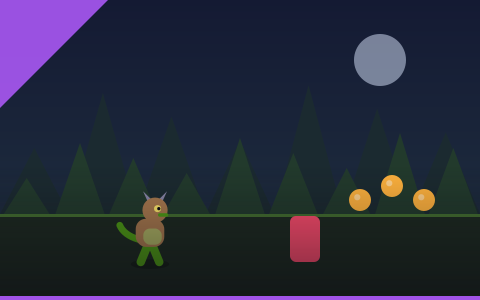
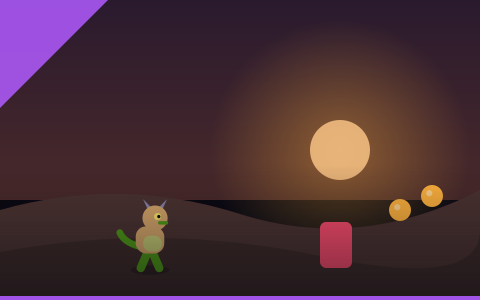
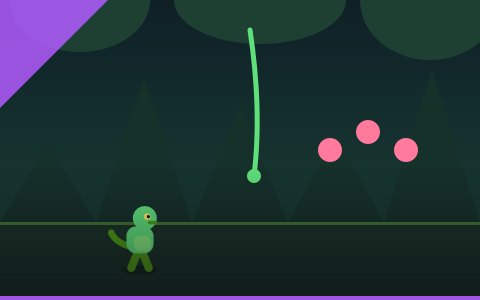
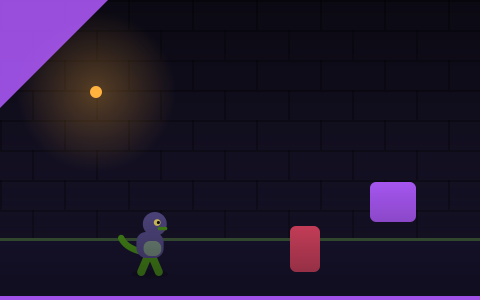
The five games here vary the pressure differently. Monster Dash is the classic two-action runner. Beast Run adds lanes, so obstacles have a horizontal dimension. Jungle Beast Run layers collectibles over the top, forcing you to choose between safety and score. Giant Monster Rush inverts the premise entirely — you are the thing being fled from, and obstacles break rather than block. Endless Monster Run is fully procedural and never repeats.
Why difficulty ramps on a curve, not a line
Speed in every runner here follows an asymptotic curve: it rises quickly at first, then more slowly, approaching a ceiling it never quite reaches. A linear ramp would eventually produce a speed at which no human could react, which makes the late game a formality rather than a challenge. A curve means a skilled player's run ends because they made a mistake, not because the game became physically impossible.
Obstacle spacing follows its own rule. There is always a minimum gap based on current speed, calculated so that the two obstacles either side of it can be handled separately. That is what keeps a procedurally generated runner fair: the generator is allowed to be cruel about what it places, never about when.
If a runner ever feels like it gave you an impossible pair of obstacles, that is a bug worth reporting. Send the game name and roughly how far you had run to our contact page.
The rhythm trap
Most players, without noticing, start jumping on a beat. The obstacles arrive at a fairly even spacing for a while, a rhythm forms, and jumping becomes musical rather than reactive. It feels wonderful and it is the reason runs end.
The moment the generator varies the spacing — and it always does — a player locked into a rhythm jumps at the beat instead of at the obstacle. The fix is deliberately unpleasant: occasionally jump slightly later than feels comfortable, which forces you back into reacting to what is on screen rather than to your internal metronome.
A related habit is holding the jump button. Variable jump height means a full-length hold is a long commitment, and a long commitment is exactly what you do not want when a low obstacle might appear under you. Tap by default; hold only when you can see that you need the height.
Escapes: the same skill with a finish line
Two games here are framed as escapes rather than endless runs, which changes the psychology more than the mechanics. When there is a finish line, the correct level of risk changes as you approach it: early on you can afford to take a greedy line for score, and in the last stretch you should take the safest possible route even if it costs points.
Players routinely get this backwards and play most carefully at the start, when a death costs them nothing, then push hardest at the end when a death costs them an entire run.
Where to start
Monster Dash is the best introduction to the whole site, not just this category — two actions, immediate feedback, restart in under a second.
Giant Monster Rush is the most novel, because being the monster changes how every obstacle reads.
Endless Monster Run has the highest ceiling and is the truest test of pure reaction.
Quick tips for monster runner & escape games
- Tap jumps by default. Hold only when you can already see you need the height.
- Watch the far edge of the screen, not the obstacle in front of you.
- If you notice yourself jumping on a beat, deliberately jump late once to break the rhythm.
- In lane runners, move to a lane because it is safe, not because it has a coin in it.
- Play the last stretch of an escape safely; play the opening greedily. Most people do the reverse.
- Take a thirty-second break after three failed runs — reaction time degrades measurably with tilt.
Monster Runner & Escape Games — FAQ
What are monster runner games?
Games where your creature moves forward automatically and you handle obstacles as they arrive by jumping, ducking or changing lane. Most are endless and scored on distance; a couple are escapes with a defined finish.
Do the levels repeat?
Endless Monster Run and Monster Dash generate obstacles procedurally, so no two runs are identical. The escape games use designed layouts that stay consistent.
Are runner games good on mobile?
They are the best category on touch. Most need only one or two large buttons, and several are comfortable one-handed. See monster arcade games on mobile.
Why do I always die at about the same distance?
Almost always because a rhythm has formed and the generator has varied the spacing. It is the most common plateau in the genre and it is fixable — see monster runner strategies.