On this page
Seven behaviours, thirty games
Every creature on this site runs one of seven movement behaviours. Learning them means a creature you have never seen before is still readable within about a second.
| Behaviour | Movement | Recognise it by |
|---|---|---|
| Patrol | Back and forth between two points | It turns at a boundary and never approaches you |
| Chase | Straight at you, continuously | Its heading tracks yours |
| Sine | Horizontal drift with a vertical wave | Perfectly regular vertical motion |
| Hop | Still, then a burst toward you on a timer | Long pauses punctuated by sudden movement |
| Charge | Crouch, then a fast straight line with overshoot | It stops moving before it moves fast |
| Keep-away | Holds a preferred distance and fires | It backs off when you approach |
| Still | Does not move at all, only attacks | Obvious, and easy to forget about |
Creatures freeze during their own wind-up
This is the most useful mechanical detail in the whole system and it is not stated anywhere in the games.
Any creature with a telegraph stops moving while the telegraph runs. A gorer preparing to charge is stationary for 0.34 seconds. A spitter preparing to fire is stationary for 0.42.
Two consequences. First, a frozen creature is a creature whose position you can predict perfectly, which makes the wind-up the best moment to reposition relative to it. Second, the freeze is itself a tell — if something that was approaching you suddenly stops, an attack is coming regardless of whether you noticed the visual telegraph.
The overshoot is a gift
Charging creatures do not stop at your position. They charge through it and overshoot, then spend a recovery window facing the wrong way.
That overshoot is deliberate and it is the free damage window in most fights. It also dictates the correct dodge: step sideways, never backwards. Backing away keeps you on the charge line and means being chased down it; stepping sideways means the creature sails past and hands you its back.
The same applies to a boss dive, which lunges to a marked position and returns.
Introduction schedules
Creature types are introduced on a schedule rather than randomly, in every game that has more than one.
In Monster Arena: crawlers immediately, snappers from round two, gorers from round four, spitters from round seven, brutes from round nine. In endless games the same schedule runs on elapsed time instead of rounds.
The purpose is that you always meet a creature alone before you meet it in a crowd. Meeting a brute in your first ten seconds teaches you nothing, because you have no context for what makes it different.
Crowds behave differently from individuals
Two systems change how a group of creatures feels compared to the same creatures alone.
Separation. Overlapping creatures push each other apart, so a crowd spreads into a ring rather than collapsing into a single point. That makes a crowd readable, and it means the gap you can see is a gap that will still exist in half a second.
Attack cooldowns are per-creature. Each one has its own timer, which means a crowd does not all hit you at once — it hits you in a staggered sequence. Getting out of a crowd immediately after one hit is usually survivable; staying is not.
Reading a crowd rather than individuals
Past about six creatures on screen, tracking each one stops being possible and stops being necessary.
What replaces it is reading the crowd's shape. Because overlapping creatures push each other apart, a group naturally spreads into an arc or a ring around you rather than collapsing into a point — which means the gaps you can see are real gaps that will still exist shortly.
So the technique is to stop looking at creatures and start looking at the space between them. Move toward the widest gap, and let the separation system keep it open for you.
The seven behaviours
Every creature in the library runs one of seven movement behaviours. Nothing combines two, which is why they stay readable at speed.
- Patrol. Back and forth on a fixed path, indifferent to you. Predictable; time your crossing.
- Chase. Moves toward you, winding up and lunging when close. Outrunnable; the lunge is the danger.
- Sine. Advances while weaving vertically. Aim at the centre of its weave, not at where it currently is.
- Hop. Periodic jumps toward you. Vulnerable while airborne, committed to its arc.
- Charge. Long telegraph, then a fast straight rush. Move perpendicular.
- Keep away. Maintains distance and attacks from range. Must be closed on or it controls the fight.
- Wander. Drifts semi-randomly. Harmless on contact terms but occupies space you wanted.
The one to kill first is always keep-away, in every game where it appears. It is the only behaviour that takes your positioning away from you, and everything else becomes easier once it is gone.
Separation, and why crowds spread out
Creatures push each other apart when they overlap, and that single rule is what keeps large groups readable.
Without it, a dozen chasers would converge into one dense blob occupying a single point, which looks like one enemy and behaves like twelve. With it, a crowd naturally spreads into an arc around you and the gaps between individuals stay real.
That is why reading the shape of a crowd works. The gaps you can see are not momentary — the separation rule is actively maintaining them — so moving toward the widest one is a reliable plan rather than a gamble on timing.
Key takeaways
- Seven behaviours cover every creature in the library, so an unfamiliar enemy is readable within a second.
- Creatures freeze during their own telegraph, which is both a prediction opportunity and a tell in itself.
- Chargers overshoot on purpose — step sideways, never backwards.
- Creature types are introduced alone before appearing in crowds.
Frequently asked questions
Why do enemies stop before attacking?
Because the telegraph freezes them. It is the clearest tell in the game and it makes their position predictable for the duration.
Which way should I dodge a charge?
Sideways. The charge is a straight line with a built-in overshoot; backing away keeps you on the line.
Do crowds attack all at once?
No. Attack cooldowns are per-creature, so a crowd hits in a staggered sequence — which is why leaving immediately after one hit usually works.
Which enemy should I kill first?
How do I handle more creatures than I can track?
Do creatures behave differently in different games?
Can creatures hurt me without attacking?

Alex Morgan
Browser Games Editor & Interactive Gaming Content Specialist
Alex Morgan is the editorial byline for everything published on Monster Arcade — the design notes behind all 30 original games, the strategy guides, and the tuning decisions that set every difficulty curve on the site. More about our editorial byline.
Published · Last updated
Games mentioned in this guide
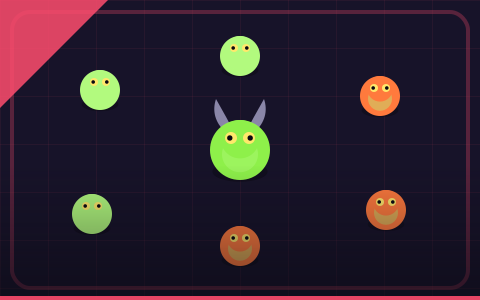
Monster Arena
Clear each round of creatures, then pick one of three permanent upgrades. Builds compound fast.
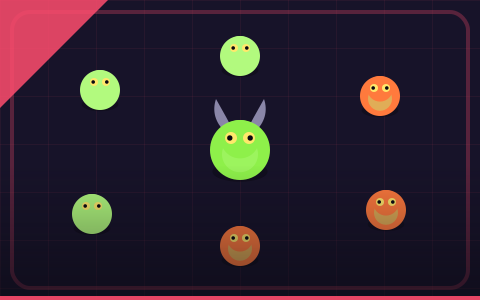
Ultimate Monster Challenge
The hardest game here. Endless waves punctuated by a boss every fifth round, in a shrinking arena.
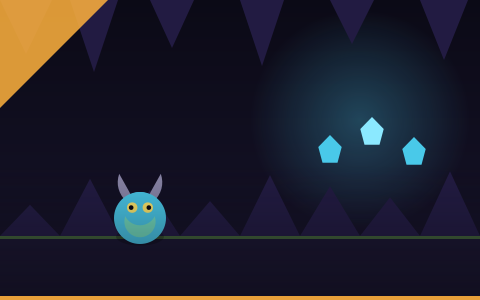
Monster Cave Quest
Explore a branching cave for twelve treasures, then find the way out before your lantern dies.

Monster Treasure Hunt
Gather treasure in an overgrown clearing while creatures wander through. The clearest combo lesson here.