Battle
Ultimate Monster Challenge
The hardest game here. Endless waves punctuated by a boss every fifth round, in a shrinking arena.
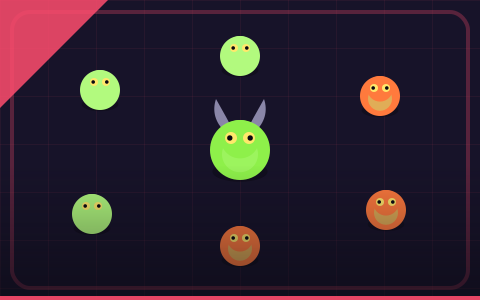
Thunder Horn fights for a living. Monster Arena is a round-based battle game in a single enclosed stone ring: clear every creature in a round, then choose one of three upgrades that lasts for the rest of the run. The upgrades compound, which means the run you are having is largely decided by your first two picks.
Survive as many rounds as you can. Each round spawns a set number of creatures; clearing them all ends the round and offers you three random upgrades, of which you take one. Your best round is your score.
| Action | Keyboard / mouse | Touch |
|---|---|---|
| Move | WASD or arrow keys | Virtual joystick |
| Attack | Mouse button or Space | Attack button |
| Dodge roll | Shift or E | Dodge button |
| Choose upgrade | 1 / 2 / 3 or click | Tap the card |
| Pause | P or Esc | Pause button in the top bar |
Pause with P or Esc, restart with R. The game pauses automatically if you switch tabs. Full details in desktop monster game controls and how to use touch controls.
The arena is small on purpose. There is nowhere to run to and no cover, so every fight is decided by spacing and timing rather than by finding a safe corner. That constraint is what makes the upgrade system interesting: a build that increases your damage changes how you fight, but a build that increases your mobility changes where you fight, and the arena is small enough for that to matter enormously.
Three creature types appear on a schedule. Snappers are fast and fragile and arrive immediately. Gorers are slower, take several hits, and charge in a straight line after a visible crouch. Spitters keep their distance and fire slow projectiles you can walk around. They are introduced at rounds one, four and seven respectively, so you always meet a new type on its own before meeting it in a crowd.
Every attack in the game has a telegraph. The Gorer's charge is preceded by a crouch of about three tenths of a second; the Spitter glows before it fires. Once you are watching for these, the game changes character entirely — it stops being about avoiding everything and becomes about choosing which single enemy you are reacting to at any moment.
There are nine upgrades in the pool and you are offered three at random after each round. Attack speed is the strongest early pick in almost every run we have tested, because it compounds with every other damage effect and shortens the window in which you are vulnerable. Raw damage is a better late pick, once Gorers have enough health that killing one is a multi-hit commitment.
Monster Arena stars Thunder Horn, an original creature created for this site, in a dungeon setting. Like every monster on Monster Arcade, Thunder Horn is drawn procedurally on canvas from primitives rather than loaded from a sprite sheet — which is why the artwork stays sharp at any screen size and why we can say without qualification that it is our own.
The creatures you face are built from the shared enemy system described in designing monster enemies. Every attack in the library telegraphs before it lands, and the obstacles follow the rules set out in designing monster obstacles. Nothing here borrows from any existing franchise; see our disclaimer for the full statement on originality.
Monster Arena records best round as your personal best. That figure is stored in this browser using localStorage and is never uploaded — there is no server here to upload it to, and no global leaderboard anywhere on the site.
Like every game in the library it uses the shared combo system: consecutive successful actions raise a multiplier, and taking damage or letting the chain time out resets it. How combo systems work explains the mechanic in full, and how scoring systems work covers what each metric actually measures.
Difficulty is rated Medium, which describes execution pressure rather than depth — see monster game difficulty explained for how we set these labels and why the curve is asymptotic rather than linear.
After every cleared round you are offered three upgrades at random from a pool of nine, and you keep the one you choose for the rest of the run. They stack, so an early pick affects every round that follows.
Attack speed, in almost every case. It shortens the time you spend committed to an attack, which is both offensive and defensive, and it multiplies the value of any damage upgrade you take later.
No, unless you take an upgrade that heals you. Managing health across rounds is a large part of how far a run goes.
No. Defeated creatures burst into coloured particles. The whole site uses a stylised arcade look rather than realistic injury.
Chosen by shared category, gameplay type, creature and environment — not at random.
The hardest game here. Endless waves punctuated by a boss every fifth round, in a shrinking arena.
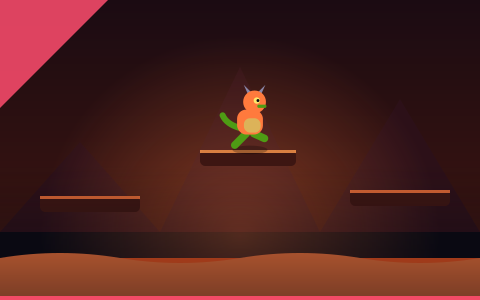
A boss you cannot kill, only outlast. Four phases, each with a pattern you have to learn cold.
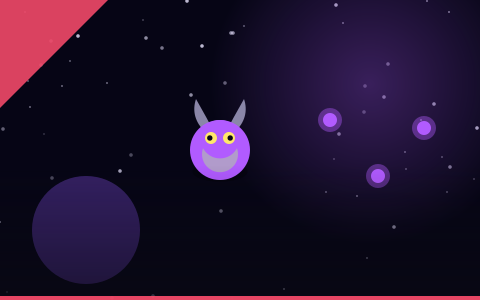
The flagship. Three stages in one run — a runner, a collection stage and a boss fight.

Launch a small fire imp at towers of blocks. Angle and power, fifteen stages, no time pressure.
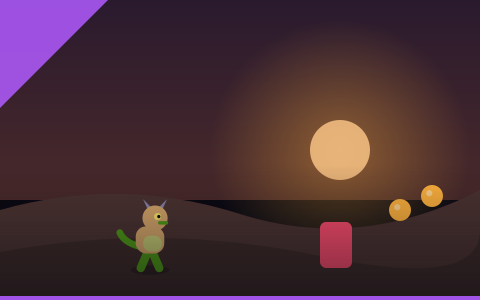
Three lanes across a desert canyon. Obstacles now have a horizontal dimension as well as a vertical one.
Dodge what falls, catch what glows. Two inputs and an increasingly crowded ceiling.
Category deep dive
Battle games are won by watching, not by reacting. How telegraphs work, why mid-distance is the most dangerous place on the board, and how wave and upgrade systems shape a run.
Systems
Seven movement behaviours cover every creature in the library. What each one does, how to recognise it within a second, and why creatures are frozen during their own wind-up.
Systems
Phases, telegraphs, the twenty per cent learning bonus and the counter-strategy for each boss design in the library. Why you should spend the first cycle of a new phase watching rather than attacking.
Browse the monster battle games, the full library of 30 games, or the newest additions. If you are not sure what to try next, let the random picker choose.