On this page
Tap, do not hold
If you take one thing from this guide: jump height is variable by hold length, and most early deaths in every platformer here are overshoots rather than undershoots.
A tap clears roughly one and a half tiles. A full hold clears three and a bit. Most tight ledges in Monster Castle are designed around the tap, which means holding is not merely imprecise — it is aimed at a different platform than the one you want.
Practise it deliberately: five levels where you never hold the button. Your first attempt will be worse and your fourth will be better than your previous best.
The four platform types
| Type | Recognise it by | Handle it by |
|---|---|---|
| Solid | A plain body with a coloured top edge | Standing on it freely |
| Crumbling | Orange top edge; shakes once touched | Crossing without stopping — it holds about 0.42 s |
| Moving | Chevrons pointing its direction of travel | Boarding just after it reverses, never mid-travel |
| Thin | A half-height top edge | Jumping up through it; hold down and jump to drop through |
The moving-platform rule is the one people fight. Boarding mid-travel means matching its speed while airborne; boarding just after it reverses means it is momentarily slow and heading back toward you. The second is far easier and costs perhaps half a second of waiting.
Crumbling stone is a floor, not a platform
Crumbling ledges hold for about four tenths of a second after contact. That is long enough to cross and far too short to stand on, which is exactly the intended reading.
Treat them as a surface you bounce off rather than land on. In Lava Beast, where a cracked ledge may be the only thing between you and the rising floor, the correct technique is to arrive already knowing where you are going next — the ledge is a stepping stone, not a decision point.
If you find yourself standing on one deliberating, you have already made the mistake.
Use the walls
Lava Beast has a wall slide and most players never touch it.
Pressing into a shaft wall while falling slows your descent to a crawl and lets you jump off it. In practical terms a wall is a free platform that is always there, which makes it the single best recovery tool in the game: a missed ledge is not a lost run if there is a wall within reach.
It is also a route in its own right. Alternating wall jumps up a narrow section is frequently faster than hunting for ledges, and the lava does not care how you got higher.
What to do when a jump goes wrong
The instinct is to correct back to the platform you meant to hit. It is almost always the wrong call.
Recovery beats correction. Look for the nearest thing below or ahead of you and commit to it. In Monster Tower a mistimed jump is recoverable surprisingly often this way, because floors are generated with at least one plain landing platform and there is usually something underneath.
Two supporting habits: keep full horizontal control while falling (you have it, and most players forget), and remember that dropping deliberately through a thin platform is often the fastest way to fix a bad approach.
Learn to fall deliberately
Falling is treated as failure by most players and is frequently the correct move.
Thin platforms can be dropped through by holding down and pressing jump, which is often the fastest way to fix a bad approach to a floor in Monster Tower. Walking around costs a second; dropping costs nothing.
More generally: you keep full horizontal control while airborne in every platformer here. A fall is a repositioning opportunity rather than a loss of control, and players who use it recover from mistakes that look unrecoverable.
Jump height is a dial, not a switch
The most underused mechanic in the category is that the jump button is analogue.
A tap produces a small hop. A full hold produces the maximum arc. Everything in between is available, and releasing mid-rise cuts your upward velocity immediately rather than letting the jump complete.
Two practical consequences. First, most overshoots are caused by holding the button when a tap would have done — so if you keep sailing past ledges, the fix is not aim but duration. Second, a short hop is much faster to recover from, so on a floor of closely spaced platforms, tapping produces both better precision and a quicker rhythm.
A useful drill: play one run of Monster Castle using only taps, never a full hold. It will feel wrong for two levels and will permanently change how you approach short gaps.
Landing where you intend to
A jump has two halves and most players only plan the first.
Deciding where to take off from is natural. Deciding where to land — which specific part of which platform, and what you will do the instant you arrive — is the half that gets skipped, and it is the reason so many successful jumps are followed immediately by a failure.
The habit worth building is to look at your landing target rather than at the gap. Your horizontal control while airborne is full, so a jump aimed at a destination can be corrected mid-flight, while a jump aimed at 'across' cannot be corrected because there is nothing to correct toward.
Key takeaways
- Tap jumps by default; overshoots cause more deaths than undershoots.
- Board moving platforms just after they reverse, never mid-travel.
- Crumbling ledges hold about 0.42 seconds — cross them, never stand on them.
- Wall slides are free platforms and the best recovery tool in Lava Beast.
- After a missed jump, commit to the nearest reachable platform rather than correcting back.
Frequently asked questions
Why do I overshoot narrow ledges?
You are holding the jump button. A tap clears about one and a half tiles, which is what tight ledges are designed around.
How long does crumbling stone last?
About four tenths of a second after contact. Long enough to cross, far too short to stand on.
How do I wall jump?
Hold the direction toward a wall while airborne. Your creature grips and slides slowly, and jump kicks off in the opposite direction.
Why do I keep overshooting short gaps?
Can I drop through a platform deliberately?
Should I be looking at the gap or at the landing platform?
Why do I sometimes fall through a platform I meant to land on?

Alex Morgan
Browser Games Editor & Interactive Gaming Content Specialist
Alex Morgan is the editorial byline for everything published on Monster Arcade — the design notes behind all 30 original games, the strategy guides, and the tuning decisions that set every difficulty curve on the site. More about our editorial byline.
Published · Last updated
Games mentioned in this guide

Monster Castle
Climb a trap-filled castle as a small round monster. Eight hand-built levels with a real ending.
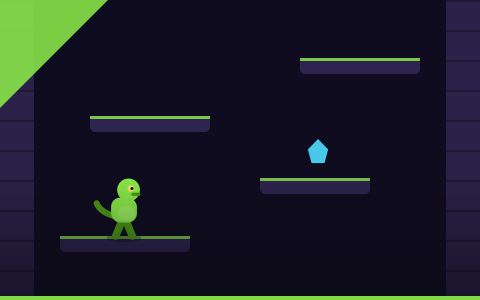
Monster Tower
An endless procedural tower. Every floor is generated, so memorising it is worthless.

Lava Beast
Climb ahead of rising lava as Ember Fang. Hesitate for a second and the floor catches you.
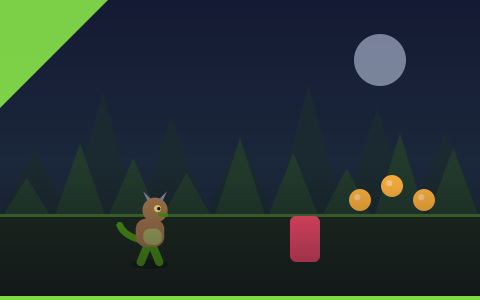
Monster Jump Challenge
One button, twenty platforms. A pure jump-timing test that teaches the skill in ninety seconds.