On this page
- The ground is the opponent
- Coyote time and jump buffering
- Variable jump height
- Why gravity is heavy here
- The five shapes a platformer can take
- The habit that costs new players the most
- Reading the platform types
- Why platformers are the best category to learn on
- The three forgiveness systems
- Platform types and what each one is for
- Where platformers go wrong
The ground is the opponent
In a platformer, nothing chases you especially hard. What kills you is a ledge that was one pixel further away than it looked, or a jump you started half a beat too late. That makes platformers the most learnable category on this site and the most satisfying to get good at, because improvement is visible almost immediately.
The category is defined by one constraint: your position is governed by gravity and your main verb is jump. That single rule changes how a level is read. In a top-down game you can stop and think. In a platformer, standing still is often the losing move, because the platform you are standing on is moving, crumbling, or about to be swept by something.
Coyote time and jump buffering
Every platformer here implements two small mercies that almost no player notices and every player benefits from.
Coyote time
For about 85 milliseconds after you walk off a ledge, a jump press still counts as a grounded jump. The name comes from cartoon physics — running off a cliff and hanging in the air for a moment before falling.
It exists because human timing error clusters tightly around the correct moment. A player who is consistently 40 milliseconds late feels like the game ignored their input; with coyote time, the same player feels accurate. The window is deliberately small enough that you can never jump from genuinely thin air.
Jump buffering
The mirror image. If you press jump slightly before landing — within about 110 milliseconds — the input is remembered and fires the instant you touch down. Without it, a player mashing jump to chain hops gets a random subset of them.
Together these two windows absorb honest human error without letting you do anything you should not be able to do. If our platformers feel precise, this is most of the reason.
Variable jump height
Four of the five platformers here have a jump whose height depends on how long you hold the button. Tapping produces a short hop; holding produces the full arc. Under the hood it is simple: releasing early cuts your upward velocity to a floor value.
This single mechanic gives one button a whole range of distances, and it is the thing new players most reliably get wrong. Almost everybody holds every jump to maximum, sails past the narrow ledge they were aiming at, and concludes the ledge was unfair.
Learning to tap is worth more than any amount of reaction speed. In Monster Castle, a tap clears about one and a half tiles and a full hold clears three and a bit; most of the tight ledges in the game are designed around the tap.
It matters in runners too. In Monster Dash, a full-height jump keeps you airborne for roughly three quarters of a second — long enough for a low obstacle to appear underneath you while you are committed.
Why gravity is heavy here
Gravity across the category sits around 2,000 pixels per second squared, which is high. Heavy gravity produces a short, snappy arc: the apex arrives quickly and the fall is decisive.
Floaty jumps feel pleasant for about thirty seconds and then become impossible to place accurately, because a long hang time gives you too much opportunity to change your mind mid-air. A snappy arc is a commitment, and a commitment is easier to aim.
There is a second, less obvious benefit. With a fast fall, the time between deciding a jump was wrong and finding out is short, which keeps the attempt-fail-retry loop tight.
The five shapes a platformer can take
Our five platformers each push the core idea somewhere different, and between them they cover most of what the genre can do:
- Monster Castle — designed levels. Static architecture, moving hazards, a route you can memorise and a real ending. The classic reading of the genre.
- Lava Beast — the floor removed. Rising lava turns a platformer into a vertical race where hesitation is always fatal.
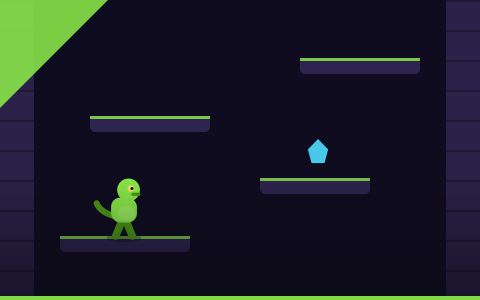
- Monster Tower — procedural. Floors are generated as you reach them, so memorisation is worthless and pattern-reading is everything.
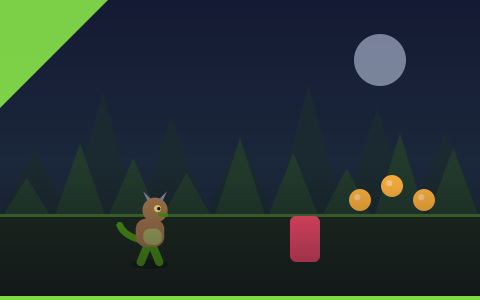
- Monster Jump Challenge — horizontal control removed. A charge-jump game where the only thing you own is the moment you release.
- Rolling Beast — jumping removed. Pure momentum over terrain, where landing angle decides how much speed survives.
The habit that costs new players the most
Looking at your own character. It feels natural — your monster is the thing you control, so your eyes follow it. But your character is the one object on screen whose position you already know, because you are the one deciding it.
The fix is to look roughly one screen-width ahead, at the place you will be in a second and a half, and let peripheral vision handle the landing. Players who make this switch usually see a jump in consistency within a single session, because the information arrives early enough to act on rather than early enough to panic about.
The second most expensive habit is panicking on a missed jump. A mistimed jump in Monster Tower is recoverable surprisingly often if you immediately commit to the next platform rather than trying to correct back to the one you meant to hit. Recovery beats correction.
Reading the platform types
Every platformer in the library uses the same four platform types, drawn the same way, which means learning them once is enough:
| Type | How it looks | How to use it |
|---|---|---|
| Solid | Plain, with a coloured top edge | Stand on it as long as you like |
| Crumbling | Orange top edge, shakes on contact | Bounce straight off — it holds for about 0.42 s |
| Moving | Motion chevrons pointing the way it travels | Board it just after it reverses, not mid-travel |
| Thin | Half-height top edge | Pass up through it; hold down + jump to drop |
Hazards are always visually distinct from scenery. If something can hurt you, it carries a warning colour, and where it moves on a cycle it telegraphs the cycle before it matters. A trap that kills you without having been readable is a bug, not a difficulty setting.
Why platformers are the best category to learn on
If you are new to arcade games generally, platformers are the place to start, and the reason is that failure here is unusually informative.
In a runner, a failed jump and a failed slide look identical: you hit something. In a battle game, a death can be the end of a chain of small mistakes made ten seconds earlier. In a platformer, you missed a specific ledge by a specific amount, in a room you can see all of, and the correction is obvious.
That tight loop between mistake and understanding is why most players improve faster here than anywhere else, and why the skills transfer outward. Variable jump height, reading a moving platform's cycle, committing to a recovery rather than a correction — all three appear in the runners and the adventure games too.
It is also the category where practising deliberately pays off most visibly. Five runs of Monster Castle where you never hold the jump button will feel worse for two attempts and better by the fourth, which is about as clean a demonstration of deliberate practice as a game can give you.
The three forgiveness systems
Platformers here feel more generous than their hitboxes suggest, and it is three specific mechanisms rather than loose collision.
Coyote time (85 milliseconds). You can still jump for a short moment after walking off an edge. Without it, a jump pressed one frame late simply does not happen, and the player experiences a button that did not work rather than a mistake they made.
Jump buffering (110 milliseconds). A jump pressed shortly before you land is remembered and fires the instant you touch ground. This is what makes chained jumps feel fluid instead of requiring frame-accurate rhythm.
Variable height. Releasing the jump button early cuts your upward velocity. The same button produces a hop or a full jump depending on how long you hold it, which turns one input into a continuous range.
All three are invisible when they work, which is the point. What you notice is that the controls feel responsive, and 'responsive' almost always turns out to mean 'the game interpreted my intention charitably'.
Platform types and what each one is for
Six platform behaviours appear across the category, and each exists to ask a different question.
- Solid. The baseline. Blocks from every direction.
- One-way. Passable from below, solid from above, and droppable through by holding down and jumping. Asks you to think about approach direction.
- Moving. Travels a fixed cycle and carries you. Asks you to read a period and commit at the right phase of it.
- Crumbling. Collapses shortly after you land. Asks you to keep moving rather than to stop and plan.
- Bouncing. Launches you upward with fixed force. Asks you to aim before you arrive, because you will not control the height.
- Conveyor. Adds constant horizontal velocity. Asks you to account for drift in every jump you make from it.
The interesting levels combine two of these rather than adding a seventh. A crumbling platform on a conveyor is a genuinely new problem built entirely from parts you already understand, and that is far better teaching than a new mechanic would be.
Where platformers go wrong
Four specific failures account for most bad platformers, and naming them is useful whether you are playing or building.
Floaty jumps. Gravity too low means a jump you cannot correct and a long, helpless descent. The games here use a relatively strong gravity with a correspondingly strong jump impulse, which produces a fast arc you retain control over.
Invisible walls. Collision geometry that does not match what is drawn. Nothing destroys trust faster, because the player's model of the world is simply wrong.
Punishing falls. A mistake near the top of a long climb sending you to the bottom converts a small error into minutes of repetition, and repetition is not difficulty.
Precision without forgiveness. Demanding exact inputs while offering no coyote time or jump buffering means the game is testing your reflexes against its frame rate rather than against a designed challenge.
Key takeaways
- Coyote time (~85 ms) and jump buffering (~110 ms) absorb honest human timing error without letting you jump from thin air.
- Jump height is variable by hold length — tapping is the single most valuable habit in the category.
- Heavy gravity makes a jump a commitment, which makes it easier to aim than a floaty one.
- Look a screen-width ahead of your creature rather than at it.
- After a missed jump, commit to the next platform rather than correcting back to the old one.
- Platformers teach fastest because failure is unusually specific — you missed a known ledge by a known amount.
Frequently asked questions
Why do my jumps feel like they sometimes do not register?
They almost certainly do. What varies is height: releasing the button early cuts the jump short. If a jump felt too small, you released early.
What is coyote time?
A short grace window — about 85 milliseconds — after walking off a ledge during which a jump press still counts as a grounded jump.
Why do I keep overshooting narrow ledges?
Because you are holding the jump button. A tap clears roughly one and a half tiles, which is what most tight ledges are designed around.
Are any of the platformers finishable?
Yes. Monster Castle has eight levels and Monster Jump Challenge has twenty platforms, both with real victory screens.
Why does my jump sometimes feel like it went further than I expected?

Alex Morgan
Browser Games Editor & Interactive Gaming Content Specialist
Alex Morgan is the editorial byline for everything published on Monster Arcade — the design notes behind all 30 original games, the strategy guides, and the tuning decisions that set every difficulty curve on the site. More about our editorial byline.
Published · Last updated
Games mentioned in this guide

Monster Castle
Climb a trap-filled castle as a small round monster. Eight hand-built levels with a real ending.

Lava Beast
Climb ahead of rising lava as Ember Fang. Hesitate for a second and the floor catches you.
Monster Tower
An endless procedural tower. Every floor is generated, so memorising it is worthless.
Monster Jump Challenge
One button, twenty platforms. A pure jump-timing test that teaches the skill in ninety seconds.

Rolling Beast
Steer a rolling creature over desert dunes. Momentum is everything and it never stops building.