
Platformer
Monster Castle
Climb a trap-filled castle as a small round monster. Eight hand-built levels with a real ending.
Monster Tower is the opposite of Monster Castle. There are no hand-built levels to memorise — every floor is generated the moment you approach it, from a set of chunk templates that get steadily nastier. You cannot learn the tower. You can only learn to read it.
Climb as many floors as possible. Each floor is a horizontal band containing platforms, a hazard arrangement and a gap to the next band. There is no lava chasing you — the pressure comes from the floors themselves getting harder, and from a floor timer that starts once you arrive.
| Action | Keyboard / mouse | Touch |
|---|---|---|
| Move left / right | Arrow keys or A / D | Left and right buttons |
| Jump (variable height) | Space, W or Up arrow | Jump button — hold for height |
| Drop through a thin platform | Hold Down + Jump | Hold down button + jump |
| Pause | P or Esc | Pause button in the top bar |
Pause with P or Esc, restart with R. The game pauses automatically if you switch tabs. Full details in desktop monster game controls and how to use touch controls.
The generator works in chunks. Each floor is assembled from a template chosen by a difficulty weighting that rises with your height, and templates are tagged with what they require: a plain gap, a moving platform, a spike row, a spinner, or a patrolling creature. Early floors draw only from the plain templates. By floor fifteen the generator is allowed to combine two requirements on one floor, and past floor thirty it can combine three.
Crucially the generator is constrained. It will never place a spike row directly under the only landing spot, and it always guarantees at least one route through a floor that does not require frame-perfect timing. Procedural generation that is allowed to be genuinely unfair is just a random number generator with extra steps; the interesting version has rules.
A soft floor timer adds the urgency that rising lava provides in Lava Beast. Linger on one floor too long and the platforms beneath you begin to shake and then fall away, which removes your retreat rather than killing you outright. It is a push rather than a punishment.
Because layouts never repeat, the skill that improves is pattern vocabulary. After twenty runs you stop seeing "a floor" and start seeing "a spinner floor with a moving-platform entry", which you already know how to solve. That is the genuine progression curve in any procedural game, and it is why an endless game can still feel like it is teaching you something.
Monster Tower stars Grumble, an original creature created for this site, in a dungeon setting. Like every monster on Monster Arcade, Grumble is drawn procedurally on canvas from primitives rather than loaded from a sprite sheet — which is why the artwork stays sharp at any screen size and why we can say without qualification that it is our own.
The creatures you face are built from the shared enemy system described in designing monster enemies. Every attack in the library telegraphs before it lands, and the obstacles follow the rules set out in designing monster obstacles. Nothing here borrows from any existing franchise; see our disclaimer for the full statement on originality.
Monster Tower records best floor as your personal best. That figure is stored in this browser using localStorage and is never uploaded — there is no server here to upload it to, and no global leaderboard anywhere on the site.
Like every game in the library it uses the shared combo system: consecutive successful actions raise a multiplier, and taking damage or letting the chain time out resets it. How combo systems work explains the mechanic in full, and how scoring systems work covers what each metric actually measures.
Difficulty is rated Medium, which describes execution pressure rather than depth — see monster game difficulty explained for how we set these labels and why the curve is asymptotic rather than linear.
Yes, from tagged chunk templates weighted by your current height. The generator is constrained so that every floor has at least one route through that does not require perfect timing.
Stay on one floor too long and the platforms below you shake and fall. It removes your retreat rather than killing you outright, which keeps the game moving without feeling arbitrary.
Lava Beast is a race against a rising floor with free-form ledges. Monster Tower is floor-by-floor with designed hazard arrangements and a gentler push. Tower rewards reading; Lava Beast rewards speed.
Yes — hold down and press jump on a thin platform. It is often the quickest way to fix a bad approach to a floor.
Chosen by shared category, gameplay type, creature and environment — not at random.
Climb a trap-filled castle as a small round monster. Eight hand-built levels with a real ending.

Climb ahead of rising lava as Ember Fang. Hesitate for a second and the floor catches you.
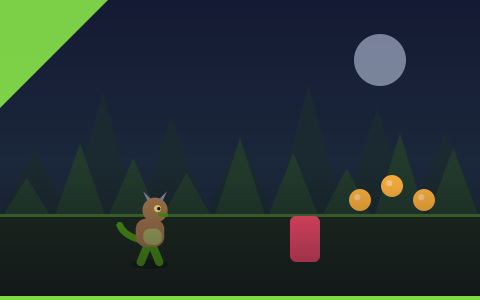
One button, twenty platforms. A pure jump-timing test that teaches the skill in ninety seconds.

Steer a rolling creature over desert dunes. Momentum is everything and it never stops building.
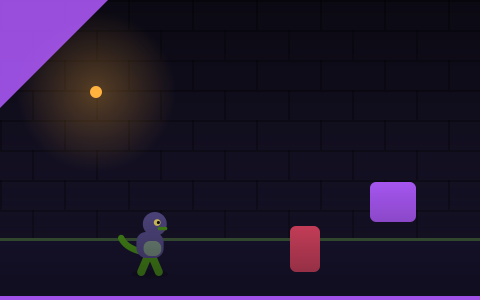
Fully procedural, no templates, no repeats. The purest reaction test in the library.
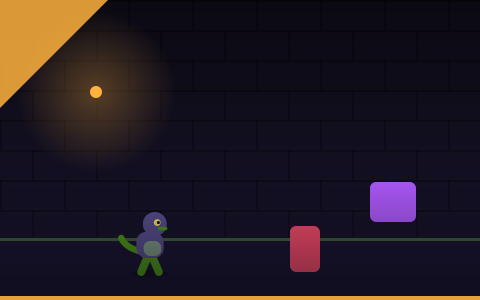
A retro-styled dungeon crawl: three keys, four wings, and a guardian that only wakes at the end.
Category deep dive
Why platformers feel precise when they are built well: coyote time, jump buffering, variable jump height, and the heavy-gravity arc that makes a jump land where you meant it to.
Systems
A closer look at the generators: tagged chunk templates, weighted selection, guaranteed routes, and the difference between a generator with rules and a random number generator.
Design notes
How a level set should escalate: one new thing at a time, a mid-set breather, and a final level that combines rather than invents. With the shapes used by our three level-based games.
Browse the monster platformer games, the full library of 30 games, or the newest additions. If you are not sure what to try next, let the random picker choose.