
Platformer
Monster Castle
Climb a trap-filled castle as a small round monster. Eight hand-built levels with a real ending.
Bog Hopper cannot walk. He can only jump, and how far he goes depends entirely on how long you hold the button. That single idea is the whole game: twenty platforms of varying distance, a gap beneath each one, and nothing to do but judge the hold.
Cross all twenty platforms without falling. Holding the button charges the jump — a short hold is a short hop, a long hold sends Bog Hopper sailing. Landing near the centre of a platform awards bonus points, so precision is worth more than survival alone.
| Action | Keyboard / mouse | Touch |
|---|---|---|
| Charge jump | Hold Space or hold mouse button | Touch and hold anywhere on the play area |
| Jump | Release | Lift your finger |
| Pause | P or Esc | Pause button in the top bar |
| Restart | R | Restart button in the top bar |
Pause with P or Esc, restart with R. The game pauses automatically if you switch tabs. Full details in desktop monster game controls and how to use touch controls.
Charge-jump games are the cleanest possible teaching tool for timing, because the input and the outcome are directly proportional and both are visible. You hold, a charge bar fills, you release, and the arc that follows is exactly what the bar promised. When you fall short, you know precisely why, which is not true of most platformers.
The charge is not linear. It ramps quickly at first and then more slowly, which means the difference between a half-second hold and a three-quarter-second hold is larger than the difference between one second and one and a quarter. That makes short jumps easy to place and long jumps a genuine commitment — exactly the right way round, because the long gaps are the ones that should feel risky.
Landing position is scored in three bands. Anywhere on the platform is a survival; the middle third is a good landing worth extra; a narrow centre strip is a perfect landing worth considerably more and it extends your combo. Since combos multiply everything that follows, a run of perfect landings is worth several times a run of scraped edges.
There is a deliberate trap in the layout. Platform eleven sits at almost exactly the distance of platform ten, and almost every player charges it identically and overshoots by a hair — because platform eleven is slightly narrower. The game is teaching you that distance and margin are different things.
Monster Jump Challenge stars Bog Hopper, an original creature created for this site, in a forest setting. Like every monster on Monster Arcade, Bog Hopper is drawn procedurally on canvas from primitives rather than loaded from a sprite sheet — which is why the artwork stays sharp at any screen size and why we can say without qualification that it is our own.
The creatures you face are built from the shared enemy system described in designing monster enemies. Every attack in the library telegraphs before it lands, and the obstacles follow the rules set out in designing monster obstacles. Nothing here borrows from any existing franchise; see our disclaimer for the full statement on originality.
Monster Jump Challenge records best score as your personal best. That figure is stored in this browser using localStorage and is never uploaded — there is no server here to upload it to, and no global leaderboard anywhere on the site.
Like every game in the library it uses the shared combo system: consecutive successful actions raise a multiplier, and taking damage or letting the chain time out resets it. How combo systems work explains the mechanic in full, and how scoring systems work covers what each metric actually measures.
Difficulty is rated Easy, which describes execution pressure rather than depth — see monster game difficulty explained for how we set these labels and why the curve is asymptotic rather than linear.
Holding the button fills a charge bar shown above Bog Hopper, and releasing jumps a distance proportional to the charge. The curve is steep at first and flattens, so long jumps require a noticeably longer hold.
Landing in the narrow centre strip of a platform. It awards significantly more points than a normal landing and extends your combo multiplier.
Yes — clearing all twenty platforms gives you a victory screen with your final score and best combo.
Yes. It is a single tap-and-hold anywhere on the play area, which makes it one of the two most comfortable one-handed games on the site.
Chosen by shared category, gameplay type, creature and environment — not at random.
Climb a trap-filled castle as a small round monster. Eight hand-built levels with a real ending.

One button, one rule: tap when the ring lines up. The purest timing game on the site.
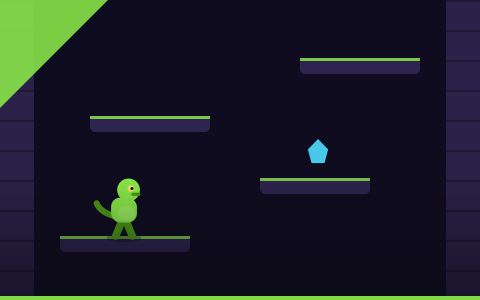
An endless procedural tower. Every floor is generated, so memorising it is worthless.

Climb ahead of rising lava as Ember Fang. Hesitate for a second and the floor catches you.

Steer a rolling creature over desert dunes. Momentum is everything and it never stops building.
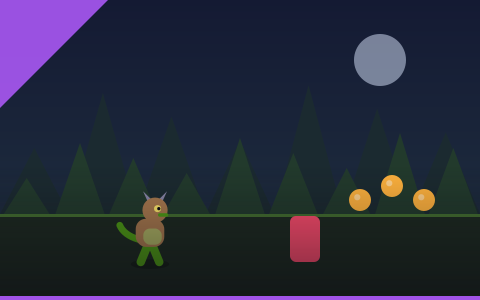
Two actions, endless forest, instant restart. The best first game on the site.
Technique
Timing is a different skill from reaction: it is about anticipating a known moment rather than responding to an unknown one. How to practise it, and why consistency beats accuracy.
Category deep dive
One button, one decision, and nothing to blame. How timing windows are sized, why we never go below 80 milliseconds, and the trap of chasing perfects.
Technique
Concrete platformer technique: reading platform types, handling crumbling stone and moving platforms, wall sliding, and what to do the instant a jump goes wrong.
Browse the monster platformer games, the full library of 30 games, or the newest additions. If you are not sure what to try next, let the random picker choose.