Battle
Monster Arcade Ultimate
The flagship. Three stages in one run — a runner, a collection stage and a boss fight.
Cinder Imp enjoys being fired out of a cannon far more than is reasonable. Monster Cannon Challenge is the only game here with no time pressure whatsoever: fifteen stages, a limited number of shots each, and as long as you like to decide on the angle and power of every one.
Knock every target creature off the structure on each stage using your allotted shots. Stages give you between two and five shots. Unused shots are worth a bonus, so solving a stage in fewer launches scores considerably higher than brute-forcing it.
| Action | Keyboard / mouse | Touch |
|---|---|---|
| Aim | Move mouse / drag | Drag on the play area |
| Set power | Drag distance from the cannon | Drag distance from the cannon |
| Launch | Release mouse button | Lift your finger |
| Retry stage | R | Restart button in the top bar |
| Pause | P or Esc | Pause button in the top bar |
Pause with P or Esc, restart with R. The game pauses automatically if you switch tabs. Full details in desktop monster game controls and how to use touch controls.
The projectile physics are honest: gravity, a drag coefficient, and elastic collisions with the blocks. Nothing is faked and nothing is assisted. What that means in practice is that the same angle and power will always produce the same arc, so a shot you liked can be repeated exactly — and a shot that failed by a small margin can be corrected by a small adjustment rather than a guess.
Structures are built from three materials with different masses and break thresholds. Timber is light and shatters easily. Stone is heavy and will not break, but it will topple, which is usually the better plan. Ice is light and shatters but also slides, which makes it useful for pulling a whole structure sideways. Learning to aim at the material rather than the target is the central skill.
There is a trajectory preview, but it is deliberately partial — it shows the first portion of the arc only. A full preview would turn the game into an arithmetic exercise. A partial one gives you enough to reason about direction while leaving the interesting part, the collision, to be predicted by you.
Because there is no clock, this is the most accessible game on the site. It is the one we point people toward when reaction speed is the barrier rather than interest — the challenge is entirely spatial reasoning, and you can take a minute over a single shot if you want to.
Monster Cannon Challenge stars Cinder Imp, an original creature created for this site, in a castle setting. Like every monster on Monster Arcade, Cinder Imp is drawn procedurally on canvas from primitives rather than loaded from a sprite sheet — which is why the artwork stays sharp at any screen size and why we can say without qualification that it is our own.
The creatures you face are built from the shared enemy system described in designing monster enemies. Every attack in the library telegraphs before it lands, and the obstacles follow the rules set out in designing monster obstacles. Nothing here borrows from any existing franchise; see our disclaimer for the full statement on originality.
Monster Cannon Challenge records best stage as your personal best. That figure is stored in this browser using localStorage and is never uploaded — there is no server here to upload it to, and no global leaderboard anywhere on the site.
Like every game in the library it uses the shared combo system: consecutive successful actions raise a multiplier, and taking damage or letting the chain time out resets it. How combo systems work explains the mechanic in full, and how scoring systems work covers what each metric actually measures.
Difficulty is rated Easy, which describes execution pressure rather than depth — see monster game difficulty explained for how we set these labels and why the curve is asymptotic rather than linear.
None at all. This is the only game on Monster Arcade with no time pressure of any kind, which makes it a good choice if reaction speed is a barrier for you.
The distance you drag from the cannon sets the power and the direction sets the angle — a single gesture on both mouse and touch.
Collisions are elastic and material-dependent. Ice slides, timber shatters and stone transfers momentum. The bounce is the physics being consistent, not random.
Fifteen, each with its own shot allowance. Clearing all fifteen is a win state with a final score based partly on shots you did not need.
Chosen by shared category, gameplay type, creature and environment — not at random.
The flagship. Three stages in one run — a runner, a collection stage and a boss fight.
Clear each round of creatures, then pick one of three permanent upgrades. Builds compound fast.
A boss you cannot kill, only outlast. Four phases, each with a pattern you have to learn cold.
The hardest game here. Endless waves punctuated by a boss every fifth round, in a shrinking arena.

Climb a trap-filled castle as a small round monster. Eight hand-built levels with a real ending.
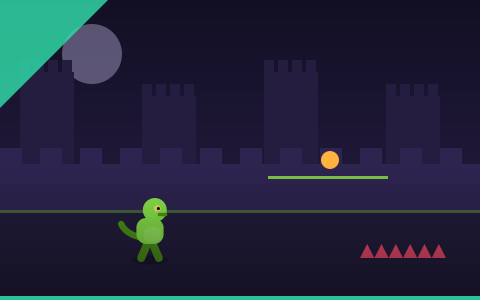
Dodge what falls, catch what glows. Two inputs and an increasingly crowded ceiling.
Category deep dive
Battle games are won by watching, not by reacting. How telegraphs work, why mid-distance is the most dangerous place on the board, and how wave and upgrade systems shape a run.
Accessibility
What we have built, what we have not, and the gaps we would rather name than imply away. Keyboard access, reduced motion, contrast, pausing and the honest limits of a canvas game.
Design notes
An obstacle is a question with exactly one correct answer. How commit cost drives spacing, why colour carries the answer, and the difference between a hazard and a trap.
Browse the monster battle games, the full library of 30 games, or the newest additions. If you are not sure what to try next, let the random picker choose.