Reflex
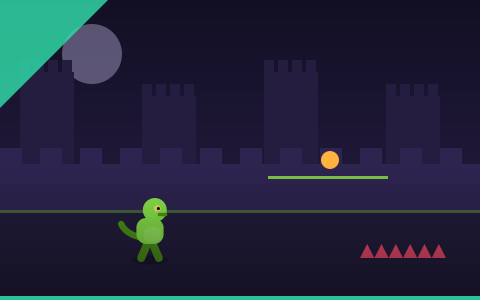
Falling Monster Frenzy
Dodge what falls, catch what glows. Two inputs and an increasingly crowded ceiling.
There is one button. A ring rotates around the Glimmer Sprite, and somewhere on that ring is a marked segment. When the rotating pointer crosses the segment, you tap. That is the whole game, and it is one of the two most played things on this site.
Tap as the pointer crosses the marked segment. Each successful tap scores, speeds up the rotation, and narrows the segment slightly. Hitting the exact centre of the segment is a perfect and extends your combo. One miss ends the run.
| Action | Keyboard / mouse | Touch |
|---|---|---|
| Tap | Space, Enter or click | Tap anywhere on the play area |
| Pause | P or Esc | Pause button in the top bar |
| Restart | R | Restart button in the top bar |
Pause with P or Esc, restart with R. The game pauses automatically if you switch tabs. Full details in desktop monster game controls and how to use touch controls.
One-button games live or die on the honesty of their timing window, and this one is deliberately generous at the start: the opening segment is about 180 milliseconds wide, which is comfortable for anyone. By tap thirty it is around 90 milliseconds, which is tight but genuinely achievable. It never goes below 80, because below that the game stops rewarding skill and starts rewarding luck.
Rotation speed and segment width both change, and they change at different rates. Early on, most of the difficulty comes from increasing speed; later, most of it comes from the narrowing segment. That shift means the skill you need at tap forty is not the skill you needed at tap ten — speed demands anticipation, width demands precision.
Scoring has two bands. Anywhere in the segment is a hit; the middle third is a perfect, worth roughly three times as much and extending a combo multiplier. The trap is obvious and everybody falls into it: chasing perfects makes you tap slightly early, and tapping slightly early is the main way runs end. Consistent hits outscore occasional perfects by a wide margin.
The game is built to be played in a spare thirty seconds and to make you want one more attempt. A run ends instantly on a miss, restarts on the same button, and shows your previous best on screen throughout — which is either motivating or maddening depending on how close you got.
One-Tap Monster stars Glimmer Sprite, an original creature created for this site, in a space setting. Like every monster on Monster Arcade, Glimmer Sprite is drawn procedurally on canvas from primitives rather than loaded from a sprite sheet — which is why the artwork stays sharp at any screen size and why we can say without qualification that it is our own.
The creatures you face are built from the shared enemy system described in designing monster enemies. Every attack in the library telegraphs before it lands, and the obstacles follow the rules set out in designing monster obstacles. Nothing here borrows from any existing franchise; see our disclaimer for the full statement on originality.
One-Tap Monster records best score as your personal best. That figure is stored in this browser using localStorage and is never uploaded — there is no server here to upload it to, and no global leaderboard anywhere on the site.
Like every game in the library it uses the shared combo system: consecutive successful actions raise a multiplier, and taking damage or letting the chain time out resets it. How combo systems work explains the mechanic in full, and how scoring systems work covers what each metric actually measures.
Difficulty is rated Easy, which describes execution pressure rather than depth — see monster game difficulty explained for how we set these labels and why the curve is asymptotic rather than linear.
It narrows from about 180 milliseconds at the start to a floor of 80. We do not go below that because tighter windows stop measuring skill and start measuring luck.
Tapping within the middle third of the marked segment. It is worth around three times a normal hit and extends your combo multiplier.
Yes — it is a single tap anywhere on the play area, making it the most comfortable one-handed game on the site.
Because you are chasing perfects. Anticipating the centre of the segment pulls your tap forward. Aim for the segment as a whole and your consistency improves immediately.
Chosen by shared category, gameplay type, creature and environment — not at random.
Dodge what falls, catch what glows. Two inputs and an increasingly crowded ceiling.

Dash between creatures on a timer. Timing and target choice at once — the hardest reflex game here.
One button, twenty platforms. A pure jump-timing test that teaches the skill in ninety seconds.
A cue appears, you answer it. Effectively a reaction-time test wearing a monster costume.

Thread a narrowing tunnel with two inputs. The smoothest difficulty curve on the site.

Climb a trap-filled castle as a small round monster. Eight hand-built levels with a real ending.
Category deep dive
One button, one decision, and nothing to blame. How timing windows are sized, why we never go below 80 milliseconds, and the trap of chasing perfects.
Technique
Specific technique for single-button games: where to look, why you keep missing early, how to handle a narrowing window, and the scoring band that is worth ignoring.
Technique
Timing is a different skill from reaction: it is about anticipating a known moment rather than responding to an unknown one. How to practise it, and why consistency beats accuracy.
Browse the monster reflex & skill games, the full library of 30 games, or the newest additions. If you are not sure what to try next, let the random picker choose.