On this page
Look at the destination, not the traveller
In One-Tap Monster a pointer rotates toward a marked segment. The instinct is to track the pointer, and it is the wrong instinct.
Tracking means your gaze arrives at the segment at the same moment your finger needs to act — leaving no margin at all. Instead, look at the segment and hold your gaze there. The pointer enters your field of view, which is a much easier judgement than estimating an arrival you are chasing.
This generalises. In every timing game here, look at where the event will happen rather than at the thing travelling toward it.
Why almost all your misses are early
In our playtests, early misses outnumber late ones substantially, and the cause is consistent: chasing perfects.
A perfect requires hitting the middle third of the segment. Aiming for it pulls your timing forward, because anticipating a small target means committing before you have full information.
The fix is to stop aiming for it. Aim for the segment as a whole; the perfects will happen on their own for roughly a third of your taps, and your consistency improves immediately. A run of thirty ordinary hits beats a run of twelve with three perfects in it, every time.
The window changes character partway through
One-Tap Monster shows the current timing window in milliseconds, and watching it explains something useful.
Early on, the window is wide and the pointer is slow — difficulty comes almost entirely from speed, and the skill is anticipation. Past roughly tap twenty, the window has narrowed considerably while speed is approaching its ceiling — difficulty now comes from precision, and the skill is accuracy.
The practical instruction is counter-intuitive: past the midpoint, slow your eyes down rather than speeding up. You are no longer trying to catch something fast, you are trying to place something exactly.
Charge games are a different skill
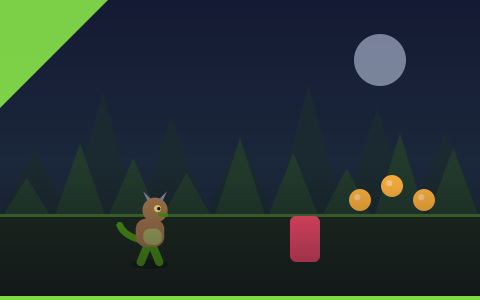
Monster Jump Challenge looks like a one-tap game and measures something else: not when but how long.
Three things matter there. First, watch the charge bar rather than the platform — the bar is the only thing you actually control. Second, release cleanly, because a hesitant release adds a few milliseconds you did not intend. Third, remember the charge curve is non-linear: it ramps quickly then flattens, so small differences in a short hold matter far more than small differences in a long one.
Platform eleven in that game sits at almost exactly the distance of platform ten and is narrower. Charging it identically is the trap the whole layout is built around.
Building a practice routine
- Five runs watching only the segment. Ignore score. You are training gaze position.
- Five runs aiming deliberately for ordinary hits, actively refusing to chase perfects. Compare your taps-survived to the previous five.
- Five runs with sound on and eyes slightly unfocused. This sounds strange and works — soft focus improves peripheral timing judgement for many people.
- Stop. Fifteen runs of a one-tap game is about six minutes and is more than enough for one session.
Do not play tired
More than any other category, one-tap games punish fatigue, and they do it in a way that is easy to misread as getting worse at the game.
Timing precision degrades noticeably before you feel tired. A session that started with consistent taps around the twentieth mark and is now ending at twelve is usually fatigue rather than a lost skill, and the correct response is to stop rather than to practise harder.
The practical rule: if three consecutive runs end earlier than your recent average, the session is over. Come back and you will typically be back at your usual level immediately, which is the clearest evidence that nothing was lost.
Finding your personal offset
Almost everybody taps consistently early or consistently late, and almost nobody knows which they are.
The way to find out is to spend one run deliberately tapping slightly later than feels right, and the next tapping slightly earlier. One of them will produce a visibly better result, and that tells you which direction your natural timing is biased in.
Once you know, the correction is a conscious adjustment rather than a skill to acquire. A player who knows they tap 40 milliseconds early can simply aim later, and the improvement arrives immediately rather than over weeks.
This is worth redoing occasionally, because the offset is not constant. It shifts with fatigue, with input device, and with how tense your hand is — which is one more reason a session that has gone badly for twenty minutes is not measuring what you think it is.
Relax your hand
The most effective physical adjustment available, and it sounds too simple to matter.
A tense hand produces taps that are both slower and more variable, and tension is the default state after a few frustrating runs. So the exact moment you are trying hardest is the moment your input is worst, which is why a session frequently gets worse rather than better as it goes on.
The correction is deliberate: unclench between runs, rest your hand rather than holding it poised, and let the tap come from the finger rather than from the wrist. Players who adopt this typically find their consistency improves more than any amount of practice had managed.
Key takeaways
- Look at the segment where the tap will happen, not at the pointer travelling toward it.
- Most misses are early, and the cause is chasing perfects.
- Early difficulty is speed and needs anticipation; late difficulty is precision and needs accuracy.
- In charge games, watch the bar and release cleanly — the curve is steep early.
Frequently asked questions
Why do I miss just before the target?
You are anticipating a perfect. Aim for the whole segment and the early bias disappears within a few runs.
Should I use sound?
Yes. Audio cues arrive slightly faster than visual ones for most people, and the timing games all carry them.
How long should a one-tap session be?
About fifteen runs, which is roughly six minutes. Timing accuracy degrades with frustration faster than almost any other skill here.
Is there a way to practise timing outside a run?
Why does the same tap sometimes work and sometimes not?
Is a phone or a keyboard better for one-tap games?
Do one-tap games get faster or just narrower?

Alex Morgan
Browser Games Editor & Interactive Gaming Content Specialist
Alex Morgan is the editorial byline for everything published on Monster Arcade — the design notes behind all 30 original games, the strategy guides, and the tuning decisions that set every difficulty curve on the site. More about our editorial byline.
Published · Last updated
Games mentioned in this guide

One-Tap Monster
One button, one rule: tap when the ring lines up. The purest timing game on the site.
Monster Jump Challenge
One button, twenty platforms. A pure jump-timing test that teaches the skill in ninety seconds.

Monster Tunnel
Thread a narrowing tunnel with two inputs. The smoothest difficulty curve on the site.