On this page
Single obstacles are never the problem
By your tenth run you have successfully cleared every individual obstacle in the game dozens of times. Nothing in a monster runner is individually difficult, and the spacing constraint guarantees that each obstacle is handleable on its own.
What ends runs is pairs — two obstacles arriving close enough together that handling the first leaves you committed when the second arrives. Since the generator enforces a minimum gap based on commit cost, a pair is never impossible; it is only impossible if you handled the first one badly.
That reframes the whole problem. You are not trying to avoid obstacles. You are trying to finish dealing with each one as quickly as possible so you are free when the next arrives.
Read the colour, not the shape
Every runner in the library uses one colour language, and learning it once covers all five games:
- Red at ground level — jump.
- Violet, floating at head height — slide.
- Amber and wide — dash. Only Endless Monster Run uses this class, and misidentifying it is the most common death there past 800 metres.
- A dark gap in the floor — jump, and hold it.
Colour resolves faster than shape, which is why the language is built on it. At the speeds these games reach you are not examining an obstacle, you are matching a category, and the category should be obvious from a glance at the edge of your vision.
Early is safer than late, always
Both jumps and slides have asymmetric failure modes, and both favour acting early.
A slide that starts too soon still clears the obstacle — you are low, the obstacle passes over you, and you stand up afterwards. A slide that starts too late never clears anything. So when in doubt about a violet obstacle, slide immediately.
Jumps are subtler. Jumping early risks landing before the obstacle arrives, which is genuinely a failure. But jumping early and short — a tap rather than a hold — gives you a short arc that lands quickly and leaves you free. Jumping late and long is the combination that kills.
The general rule: shorten your commitment rather than delaying your decision. A short early response leaves you available; a long late one does not.
The three habits that cause most collisions
- Holding the jump button. A full-height jump keeps you airborne for about three quarters of a second. That is long enough for a second obstacle to appear underneath you while you can do nothing. Tap by default.
- Watching your own creature. Your creature's position is the one thing you already know. Watch the edge of the screen where obstacles enter.
- Falling into a rhythm. Obstacles arrive at fairly even spacing for a while, a beat forms, and you start jumping to the beat rather than to the obstacle. The moment spacing varies, you are wrong.
The rhythm habit is the hardest to break because it feels good. The fix is deliberately uncomfortable: every twenty seconds or so, jump slightly later than feels right. It forces you back into reacting to what is on screen.
Obstacles that are not in a runner
Two other games are essentially obstacle-avoidance exercises with different geometry.
Falling Monster Frenzy drops obstacles from above in a narrow courtyard. The key rule there is that size signals speed — larger rubble falls faster, which lets you sort arrival order at a glance rather than tracking each object. Pick the column that will be safe in a second, not the one that is safe now.
Beast Run adds lanes, which means an obstacle occupies a position as well as a height. The response to the obstacle in front of you frequently depends on the one behind it, so read the second formation rather than reacting faster to the first.
Commit cost, and why it decides everything
Every avoidance action locks you into it for a known length of time, and that length is the number that actually matters when you choose between them.
A jump commits you for roughly 0.55 seconds, a slide for 0.45, a dash for 0.4. During that window you cannot switch to a different response — so the decision is not 'which action clears this obstacle' but 'which action clears this obstacle and leaves me free in time for the next one'.
That reframing changes several habits. A slide is usually better than a jump when both would work, because it is shorter and it keeps you near the ground where your options are widest. A dash is better than either when the obstacle is close, because it is the shortest commitment available and its brief invulnerability covers a misjudgement.
It also explains the most common runner death, which is not misreading an obstacle but clearing one with an action so long that the next obstacle arrived while you were still in the air. The generator guarantees this cannot happen with a minimum-length response; it does not protect you from choosing an unnecessarily expensive one.
Obstacles you should not avoid
A handful of things that look like hazards are not, and routing around them costs you for no reason.
Background scenery never collides. Anything drawn behind the play plane — distant rock formations, foliage, structures — is decoration, and it is drawn at lower contrast specifically so that it reads as scenery rather than as danger.
Smashable objects in the giant games are obstacles you are meant to go through. Decorative creatures that wander without a behaviour attached cannot hurt you. And in several games, a hazard that has already fired is inert during its recovery — the moment after a spike retracts is the safest time to cross it.
The general rule is that anything genuinely dangerous is drawn with higher contrast than its surroundings and appears consistently across games. If something looks ambiguous, it is almost certainly scenery, because real hazards are deliberately unambiguous.
Key takeaways
- Single obstacles are never the problem — pairs are, and a pair is only unmanageable if you handled the first one badly.
- Colour resolves faster than shape: red means jump, violet means slide, amber means dash.
- Shorten your commitment rather than delaying your decision.
- Tap jumps, watch the screen edge, and break your rhythm deliberately every twenty seconds.
Frequently asked questions
Should I jump early or late?
Early and short. A tapped jump lands quickly and leaves you free for the next obstacle; a held jump commits you for about three quarters of a second.
Why do I clear obstacles individually but still crash?
Because you are still committed from the previous one. The fix is finishing each response faster, not reacting to each obstacle faster.
How do I tell a slide obstacle from a jump obstacle in time?
By colour rather than shape. Violet floats at head height and needs a slide; red sits on the ground and needs a jump.
Is jumping or sliding better when both would work?
Can two obstacles ever require actions that overlap?

Alex Morgan
Browser Games Editor & Interactive Gaming Content Specialist
Alex Morgan is the editorial byline for everything published on Monster Arcade — the design notes behind all 30 original games, the strategy guides, and the tuning decisions that set every difficulty curve on the site. More about our editorial byline.
Published · Last updated
Games mentioned in this guide
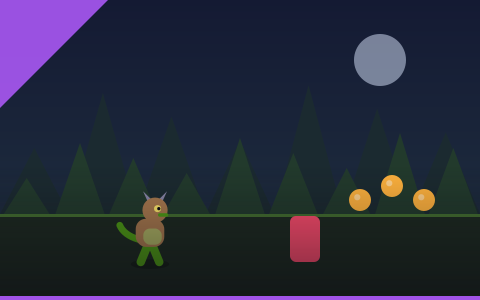
Monster Dash
Two actions, endless forest, instant restart. The best first game on the site.
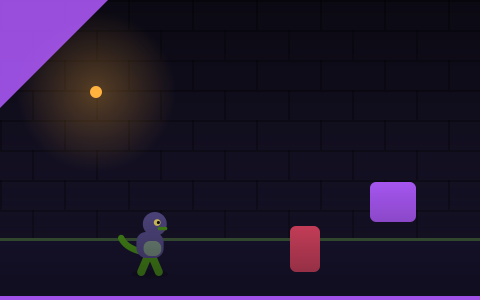
Endless Monster Run
Fully procedural, no templates, no repeats. The purest reaction test in the library.
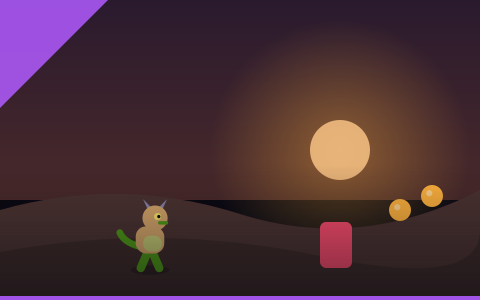
Beast Run
Three lanes across a desert canyon. Obstacles now have a horizontal dimension as well as a vertical one.
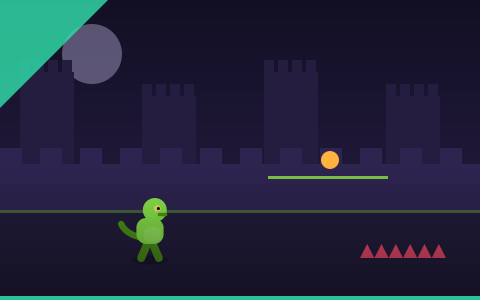
Falling Monster Frenzy
Dodge what falls, catch what glows. Two inputs and an increasingly crowded ceiling.