
Runner
Giant Monster Rush
You are the monster. Obstacles break instead of blocking — but breaking them still costs you speed.
Every other runner on the site assembles its track from chunk templates, which means an experienced player eventually recognises sequences. Endless Monster Run generates each obstacle individually from a constrained ruleset, so there is nothing to recognise. It is the hardest runner here and the fairest.
Run as far as you can through a shifting dungeon corridor using three actions: jump, slide and dash. Obstacles are generated one at a time with only a minimum-gap constraint, so sequences are genuinely unpredictable.
| Action | Keyboard / mouse | Touch |
|---|---|---|
| Jump | Space, W or Up arrow | Jump button |
| Slide | S or Down arrow | Slide button |
| Dash | Shift or E | Dash button |
| Pause | P or Esc | Pause button in the top bar |
Pause with P or Esc, restart with R. The game pauses automatically if you switch tabs. Full details in desktop monster game controls and how to use touch controls.
Template-based generation is the standard approach in runners because it guarantees playability: if every chunk is hand-checked, every combination of chunks is at least possible. The cost is that players eventually learn the chunks. Per-obstacle generation removes that ceiling, but it puts all the responsibility for fairness on the constraint system.
The constraints here are simple and strict. Each obstacle has a recovery cost — how long the player is committed after handling it — and the generator will not place the next obstacle inside that window plus a reaction allowance. The allowance shrinks as the run progresses, from about 420 milliseconds early on to a floor of 260, which is where the difficulty actually comes from.
Three actions rather than two is what makes per-obstacle generation interesting. With jump and slide alone, an obstacle is a binary and the generator has little to work with. The dash adds a third option that is correct for a specific narrow case — obstacles that are too wide to jump and too tall to slide — and misidentifying it is the most common cause of death past 800 metres.
Because there is nothing to memorise, improvement in this game is purely improvement in classification speed. It is the closest thing on the site to a measurement instrument, and we use it internally as one: if a change to the engine's input handling adds latency, this is the game where it shows up first.
Endless Monster Run stars Nix, an original creature created for this site, in a dungeon setting. Like every monster on Monster Arcade, Nix is drawn procedurally on canvas from primitives rather than loaded from a sprite sheet — which is why the artwork stays sharp at any screen size and why we can say without qualification that it is our own.
The creatures you face are built from the shared enemy system described in designing monster enemies. Every attack in the library telegraphs before it lands, and the obstacles follow the rules set out in designing monster obstacles. Nothing here borrows from any existing franchise; see our disclaimer for the full statement on originality.
Endless Monster Run records best distance as your personal best. That figure is stored in this browser using localStorage and is never uploaded — there is no server here to upload it to, and no global leaderboard anywhere on the site.
Like every game in the library it uses the shared combo system: consecutive successful actions raise a multiplier, and taking damage or letting the chain time out resets it. How combo systems work explains the mechanic in full, and how scoring systems work covers what each metric actually measures.
Difficulty is rated Hard, which describes execution pressure rather than depth — see monster game difficulty explained for how we set these labels and why the curve is asymptotic rather than linear.
Yes. Every other runner builds its track from pre-checked chunks. This one generates each obstacle individually under a constraint system, so sequences never repeat.
It is enforced to be. The generator will not place an obstacle inside the recovery window of the previous one plus a reaction allowance, so every obstacle is individually handleable.
Only for wide barriers — obstacles too wide to jump and too tall to slide. Dashing at the wrong obstacle type is as fatal as doing nothing.
Because the reaction allowance shrinks to 260 milliseconds and there is nothing to memorise. Simplicity and difficulty are unrelated.
Chosen by shared category, gameplay type, creature and environment — not at random.
You are the monster. Obstacles break instead of blocking — but breaking them still costs you speed.
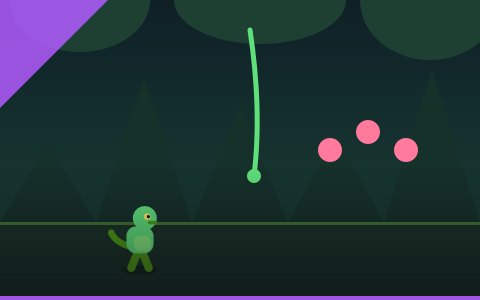
A runner that scores fruit as well as distance, so the safe line and the best line diverge.
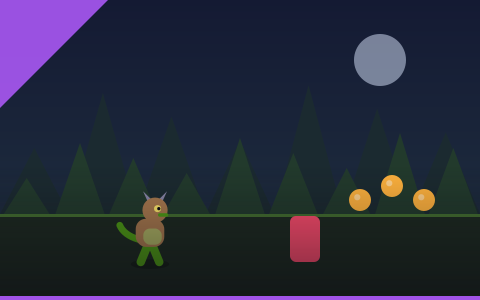
Two actions, endless forest, instant restart. The best first game on the site.
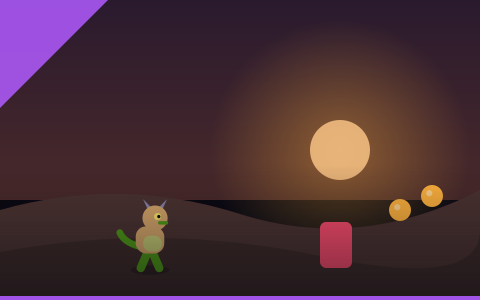
Three lanes across a desert canyon. Obstacles now have a horizontal dimension as well as a vertical one.

Climb ahead of rising lava as Ember Fang. Hesitate for a second and the floor catches you.
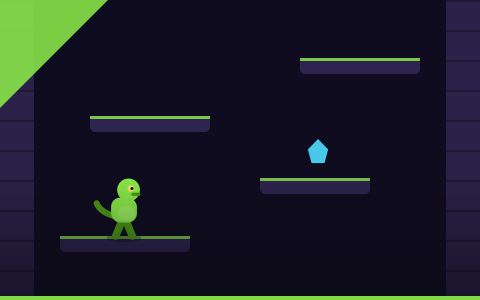
An endless procedural tower. Every floor is generated, so memorising it is worthless.
Systems
How a game generates content that has never existed before and is still fair. Chunk templates versus per-obstacle generation, the constraint that guarantees playability, and what improves when nothing repeats.
Systems
A closer look at the generators: tagged chunk templates, weighted selection, guaranteed routes, and the difference between a generator with rules and a random number generator.
Technique
What is fixed, what is trainable, and the four components of a response that you can genuinely shorten — with a practice routine built from games on this site.
Browse the monster runner & escape games, the full library of 30 games, or the newest additions. If you are not sure what to try next, let the random picker choose.