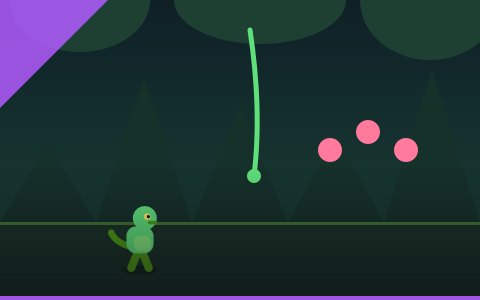
Runner
Jungle Beast Run
A runner that scores fruit as well as distance, so the safe line and the best line diverge.
The Brumble Beast is running through a forest for reasons he has not shared with anyone. Monster Dash gives you exactly two verbs — jump and slide — and then asks how long you can keep choosing the right one. It is the simplest game on Monster Arcade and the one we recommend everyone starts with.
Run as far as you can. Obstacles arrive from the right: high ones you slide under, low ones you jump over, and occasional stacked pairs that need a jump immediately followed by a slide. Distance is your score and speed increases along a curve that never becomes impossible.
| Action | Keyboard / mouse | Touch |
|---|---|---|
| Jump (variable height) | Space, W or Up arrow | Jump button |
| Slide | S or Down arrow | Slide button |
| Pause | P or Esc | Pause button in the top bar |
| Restart | R | Restart button in the top bar |
Pause with P or Esc, restart with R. The game pauses automatically if you switch tabs. Full details in desktop monster game controls and how to use touch controls.
A two-action runner is the purest measurement of reaction and classification that exists in arcade games. There is no route to plan, no resource to manage and no aiming. An obstacle appears, you identify which type it is, and you press the correct button. Everything you can improve — recognition speed, gaze position, keeping calm after a mistake — shows up immediately in your distance.
Obstacle spacing is governed by a minimum-gap rule tied to current speed. The generator calculates how long a player needs to complete a jump and recover, and never places the next obstacle inside that window. This is what makes a procedural runner fair: the generator can be as nasty as it likes about what it places, but never about when.
Speed follows an asymptotic curve, rising quickly over the first thirty seconds and then more slowly toward a ceiling. A linear ramp would eventually reach a speed no human could react to, turning the late game into a formality. With a curve, a skilled run ends because of a mistake rather than because physics ran out.
The jump is variable height, and that matters more here than players expect. A full-height jump keeps the Brumble Beast in the air for roughly three quarters of a second, which is long enough for a low obstacle to appear underneath him. Tapping by default and holding only when you can see you need the height is the single biggest improvement most players make.
Monster Dash stars Brumble Beast, an original creature created for this site, in a forest setting. Like every monster on Monster Arcade, Brumble Beast is drawn procedurally on canvas from primitives rather than loaded from a sprite sheet — which is why the artwork stays sharp at any screen size and why we can say without qualification that it is our own.
The creatures you face are built from the shared enemy system described in designing monster enemies. Every attack in the library telegraphs before it lands, and the obstacles follow the rules set out in designing monster obstacles. Nothing here borrows from any existing franchise; see our disclaimer for the full statement on originality.
Monster Dash records best distance as your personal best. That figure is stored in this browser using localStorage and is never uploaded — there is no server here to upload it to, and no global leaderboard anywhere on the site.
Like every game in the library it uses the shared combo system: consecutive successful actions raise a multiplier, and taking damage or letting the chain time out resets it. How combo systems work explains the mechanic in full, and how scoring systems work covers what each metric actually measures.
Difficulty is rated Easy, which describes execution pressure rather than depth — see monster game difficulty explained for how we set these labels and why the curve is asymptotic rather than linear.
Yes. Obstacles are generated procedurally and there is no finish line — your score is distance travelled.
Almost always because a jumping rhythm has formed and the generator has varied the spacing. It is the most common plateau in the genre — see monster runner strategies.
No. Speed approaches a ceiling rather than rising indefinitely, and obstacle spacing always leaves enough room to handle each obstacle separately.
Nearly — it needs two buttons, jump and slide. For genuinely one-handed play, try One-Tap Monster.
Chosen by shared category, gameplay type, creature and environment — not at random.
A runner that scores fruit as well as distance, so the safe line and the best line diverge.
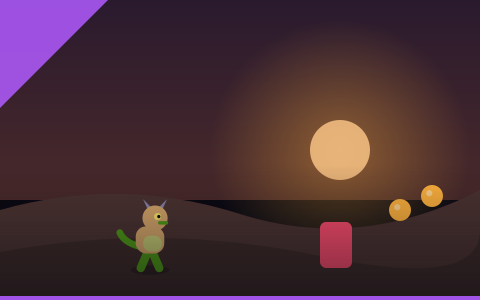
Three lanes across a desert canyon. Obstacles now have a horizontal dimension as well as a vertical one.

You are the monster. Obstacles break instead of blocking — but breaking them still costs you speed.
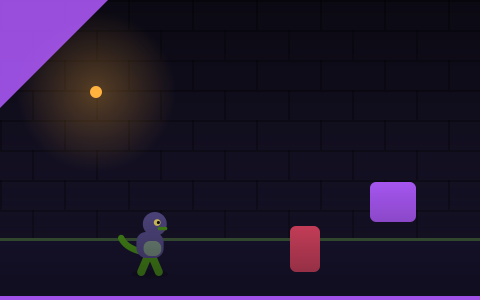
Fully procedural, no templates, no repeats. The purest reaction test in the library.

Gather treasure in an overgrown clearing while creatures wander through. The clearest combo lesson here.
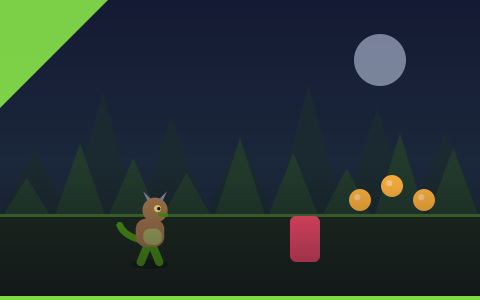
One button, twenty platforms. A pure jump-timing test that teaches the skill in ninety seconds.
Category deep dive
Runners are the easiest category to start and the hardest to hold. What separates the five here, why every run ends the same way, and the rhythm trap that causes most plateaus.
Strategy
How to add distance to an endless run: breaking your own rhythm, managing commitment length, deciding how greedy to be with collectibles, and the session-level habits that matter more than any single technique.
Technique
Obstacles are not the problem — pairs of obstacles are. How to read the visual language, why early is safer than late, and the three habits that cause most avoidable collisions.
Browse the monster runner & escape games, the full library of 30 games, or the newest additions. If you are not sure what to try next, let the random picker choose.