
Platformer
Lava Beast
Climb ahead of rising lava as Ember Fang. Hesitate for a second and the floor catches you.
Pebble Pup is a monster shaped like a boulder, which is convenient because the desert he lives in is nothing but hills. Rolling Beast has no jump button. You have exactly two inputs — lean forward and lean back — and everything else is momentum, gravity and the shape of the ground.
Roll as far as you can. Leaning into a downslope accelerates you; leaning back on an upslope stops you stalling. Launch off crests for airtime bonuses, but land wheel-down — landing badly costs you most of your speed, and speed is the only thing keeping you ahead of the collapsing dunes behind.
| Action | Keyboard / mouse | Touch |
|---|---|---|
| Lean forward | Right arrow or D | Right button |
| Lean back | Left arrow or A | Left button |
| Pause | P or Esc | Pause button in the top bar |
| Restart | R | Restart button in the top bar |
Pause with P or Esc, restart with R. The game pauses automatically if you switch tabs. Full details in desktop monster game controls and how to use touch controls.
This is the only game on the site built around continuous physics rather than discrete jumps. Pebble Pup accelerates down slopes, decelerates up them, and keeps whatever velocity he has accumulated. Leaning shifts his weight forward or back, which changes how he takes a slope and how he rotates in the air.
The crucial mechanic is rotation on landing. Come down roughly flat and you keep almost all your speed. Come down at a steep angle and you lose most of it in a graceless bounce. There is no crash-and-die here; wiping out costs you momentum, and running out of momentum is what ends the run, because the dunes behind you collapse at a fixed rate.
That makes Rolling Beast a game about conserving something rather than avoiding something. Every decision is a trade: a big crest gives airtime points but risks a bad landing; hugging the terrain is slow but safe. The optimal line is neither — it is taking moderate air off every crest and landing clean, over and over.
The terrain is generated as a smooth noise function rather than from templates, so the dunes flow continuously rather than snapping between shapes. Amplitude grows with distance, which means late in a run the hills are tall enough that a badly taken crest can launch you high enough to lose several seconds of control.
Rolling Beast stars Pebble Pup, an original creature created for this site, in a desert setting. Like every monster on Monster Arcade, Pebble Pup is drawn procedurally on canvas from primitives rather than loaded from a sprite sheet — which is why the artwork stays sharp at any screen size and why we can say without qualification that it is our own.
The creatures you face are built from the shared enemy system described in designing monster enemies. Every attack in the library telegraphs before it lands, and the obstacles follow the rules set out in designing monster obstacles. Nothing here borrows from any existing franchise; see our disclaimer for the full statement on originality.
Rolling Beast records best distance as your personal best. That figure is stored in this browser using localStorage and is never uploaded — there is no server here to upload it to, and no global leaderboard anywhere on the site.
Like every game in the library it uses the shared combo system: consecutive successful actions raise a multiplier, and taking damage or letting the chain time out resets it. How combo systems work explains the mechanic in full, and how scoring systems work covers what each metric actually measures.
Difficulty is rated Medium, which describes execution pressure rather than depth — see monster game difficulty explained for how we set these labels and why the curve is asymptotic rather than linear.
No. Airtime comes entirely from rolling off the crest of a hill with enough speed. Your only inputs are lean forward and lean back.
You lose most of your momentum but you do not die. Running out of momentum is what ends the run, because the collapsing dunes behind you move at a fixed rate.
From a smooth noise function rather than chunk templates, so hills flow continuously. Amplitude increases with distance travelled.
It sits in the platformer category because gravity and terrain govern your position, but it is the most physics-driven game on the site. If you like it, Monster Cannon Challenge uses the same physics engine differently.
Chosen by shared category, gameplay type, creature and environment — not at random.
Climb ahead of rising lava as Ember Fang. Hesitate for a second and the floor catches you.

An endless procedural tower. Every floor is generated, so memorising it is worthless.

Climb a trap-filled castle as a small round monster. Eight hand-built levels with a real ending.
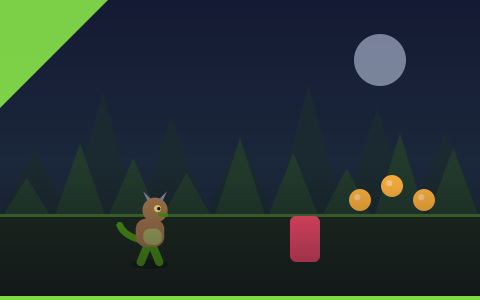
One button, twenty platforms. A pure jump-timing test that teaches the skill in ninety seconds.
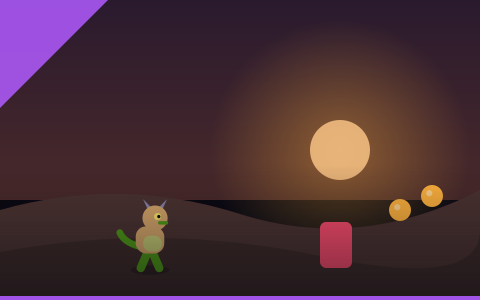
Three lanes across a desert canyon. Obstacles now have a horizontal dimension as well as a vertical one.

You are the monster. Obstacles break instead of blocking — but breaking them still costs you speed.
Category deep dive
Why platformers feel precise when they are built well: coyote time, jump buffering, variable jump height, and the heavy-gravity arc that makes a jump land where you meant it to.
Systems
A closer look at the generators: tagged chunk templates, weighted selection, guaranteed routes, and the difference between a generator with rules and a random number generator.
Design notes
An obstacle is a question with exactly one correct answer. How commit cost drives spacing, why colour carries the answer, and the difference between a hazard and a trap.
Browse the monster platformer games, the full library of 30 games, or the newest additions. If you are not sure what to try next, let the random picker choose.