

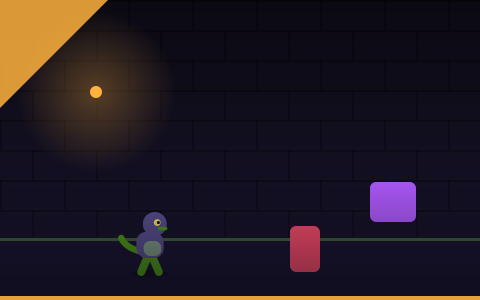
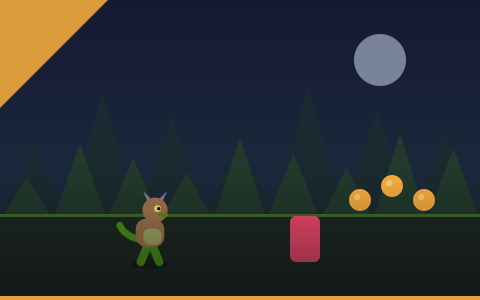

What an arcade adventure game actually is
The word "adventure" carries a lot of baggage from long story-driven games. Here it means something much more specific: a game with spatial freedom and an objective. You are not being pushed forward by a scrolling camera and you are not pinned to an arena. You can go left, and sometimes going left is correct.
That freedom is what creates the category's characteristic decision: the shortest route and the safest route are almost never the same one. Monster Cave Quest hides its treasure down dead-end branches. Monster Escape gives you a locked exit and scatters the keys across the most dangerous rooms. Underwater Monster Quest adds an oxygen meter, so every detour costs a resource you can watch draining.
Routing, not reflexes
The skill that separates a good adventure run from a bad one is route memory. On your first attempt at a cave you are exploring; by your third you should be executing. That progression is the entire point of the category, and it is why these games reward replay differently from an endless runner — you are not getting faster, you are getting better informed.
A practical technique: on a failed run, spend ten seconds before restarting recalling the order you visited rooms in, not the layout. Order is what you actually control. Most players who plateau in Monster Cave Quest are collecting the right items in the wrong sequence and walking the same corridor four times.
- Clear dead ends before you take the route that opens the exit, not after.
- Pick up a key on the way past something, never as a dedicated trip.
- If two branches look equally rewarding, take the one nearer your escape route first.
- Treat a corridor you have already cleared as a safe lane and use it to reposition.
How the creatures behave
Enemies in adventure games are obstacles with rules rather than threats that hunt you relentlessly. Most patrol a fixed path, a few drift on a sine wave, and a small number will chase you but only within a limited radius — step outside it and they return to their route.
This is a deliberate design choice. A relentless chaser turns an exploration game into a running game, which is what the runner category is for. Here, the creature is a moving wall you have to time, which keeps the emphasis on where you go rather than how fast you can flee.
The exception is the guardian in Pixel Monster Adventure, which wakes when you take the final treasure. That single late chase exists to make the last thirty seconds of a successful run tense, and it is deliberately the only part of the game you cannot solve by thinking slowly.
Gravity, oxygen and the cost of a detour
Two games in this category add a resource that turns routing into a genuine trade. Underwater Monster Quest gives you an oxygen bar that refills at surface bubbles, so every deep detour is borrowed time. Gravity Monster lets you flip which way down is, which means the safest path is frequently the ceiling.
Both mechanics do the same job: they stop the optimal route from being obvious. A game where the best path is visible at a glance is a maze, not an adventure.
Where to start
Monster Cave Quest is the clearest introduction — readable layout, generous lighting, and a treasure count that tells you exactly how much you have left to find.
If you like a puzzle in your movement, Gravity Monster is the most mechanically distinct game on the whole site.
If you want the longest single run, Pixel Monster Adventure has the biggest map and a proper ending.
Quick tips for monster adventure games
- Explore dead ends first; save the route that opens the exit for last.
- Never make a dedicated trip for a collectible — pick it up in passing or leave it.
- Patrolling creatures are safest to pass just after they turn around.
- In Underwater Monster Quest, surface before you think you need to. The last 20% drains fastest.
- Memorise the order you visit rooms in, not the map. Order is the part you control.
- A cleared corridor is a safe lane — use it to reposition rather than cutting through new ground.
Monster Adventure Games — FAQ
What is a monster adventure game?
An arcade adventure game gives you a space to move around freely and an objective to complete — usually collecting a set number of items and reaching an exit. The skill is route planning and map memory rather than reaction speed.
Are these games longer than the other categories?
Yes. A typical adventure run lasts three to eight minutes against roughly one to two for a runner or reflex game. They are the best category to pick when you want a single satisfying session rather than repeated short attempts.
Can I actually complete them?
All five have a real win state, which is unusual on this site. Most other categories are endless and scored. See monster adventure games explained for how the objectives differ.
Do I need to memorise the maps?
It helps enormously but is not required. Every layout is readable on sight, and the games show you how many collectibles remain. Memory turns a survivable run into an efficient one.