


What makes a game a monster platformer
A platformer, in arcade terms, is any game where your position is governed by gravity and your main verb is jump. That single constraint changes everything about how a level is read. In a top-down game you can stop and think; in a platformer, standing still is often the losing move, because the platform you are standing on is moving, crumbling, or about to be swept by something.
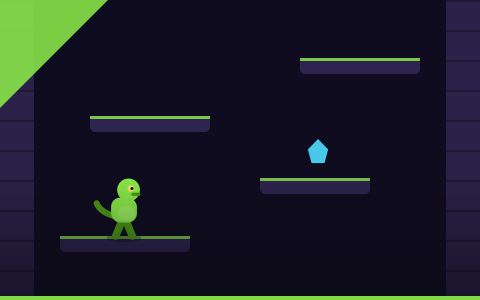
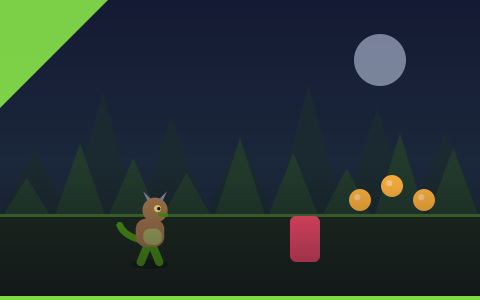
The five games here each push that idea somewhere different. Monster Castle is the classic reading: static architecture, moving hazards, and a route you can memorise. Lava Beast takes the floor away entirely — the ground rises behind you, so a platformer becomes a vertical race. Monster Tower is procedural and endless, so memorisation is worthless and pattern-reading is everything. Monster Jump Challenge strips away horizontal control so the only thing you own is the moment you press. And Rolling Beast replaces jumping with momentum: you steer a creature that never stops moving.
Coyote time, jump buffering and why our jumps feel forgiving
Every platformer on this site implements two small mercies that almost no player notices and every player benefits from. The first is coyote time: for about six hundredths of a second after you walk off a ledge, a jump press still counts as a grounded jump. The second is jump buffering: if you press jump slightly before landing, the input is held and fires the instant you touch down.
Both exist because human timing error clusters tightly around the correct moment. Without them, a player who is consistently three hundredths of a second early feels like the game is broken rather than like they are nearly right. With them, the same player feels precise. The windows are deliberately small — large enough to absorb honest error, too small to let you jump from thin air.
Jump height is also variable in four of the five games. Tapping produces a short hop and holding produces the full arc, which means a single button gives you a whole range of distances. New players almost always hold every jump to maximum and then overshoot; learning to tap is usually worth more than any amount of reaction speed.
How our platformers are tuned
Gravity across the category sits deliberately heavy — around 2,000 pixels per second squared in the side-view games. Heavy gravity produces a short, snappy arc where the apex arrives quickly and the fall is decisive. Floaty jumps feel pleasant for about thirty seconds and then become impossible to place accurately, because a long hang time gives you too much opportunity to change your mind mid-air.
Hazards are always visually distinct from scenery. If something in a platformer can hurt you, it carries a warning colour and, where it moves on a cycle, it telegraphs the cycle before it matters. A trap that kills you without having been readable is a bug, not a difficulty setting.
The first thirty seconds of every game on Monster Arcade is survivable by a first-time player. That is a rule across the site, not a coincidence — you should always get long enough to learn what the buttons do before the game starts pushing back.
The habit that costs new platformer players the most
Looking at your own character. It feels natural — your monster is the thing you control, so your eyes follow it. But in a platformer your character is the one object on screen whose position you already know, because you are the one deciding it.
The fix is to look roughly one screen-width ahead of yourself, at the place you will be in a second and a half, and let your peripheral vision handle the landing. Players who make this switch usually see a jump in consistency within a single session, because the information arrives early enough to act on rather than early enough to panic about.
The second most expensive habit is panicking on a missed jump. A mistimed jump in Monster Tower is recoverable surprisingly often if you immediately commit to the next platform rather than trying to correct back to the one you meant to hit. Recovery beats correction.
Where to start
If you have not played a platformer in a while, start with Monster Castle. It has hand-built levels with a real ending, which means you can finish it rather than simply lose eventually.
If you only have two minutes, Monster Jump Challenge is a single-button game that teaches jump timing faster than anything else on the site.
If you want the hardest thing here, Lava Beast removes any possibility of standing still and punishes hesitation more than any other game in the category.
Quick tips for monster platformer games
- Tap for short hops, hold for full height. Most early deaths are overshoots, not undershoots.
- Look a screen-width ahead of your monster, not at it — you already know where you are.
- After a missed jump, commit to the next platform instead of correcting back to the old one.
- Moving platforms are easiest to board just after they change direction, not mid-travel.
- Falling hazards telegraph before they drop. If you are reacting to the drop, you are already late.
- Use the pause key between hard sections; there is no timer penalty for thinking in these games.
Monster Platformer Games — FAQ
What is a monster platformer game?
A platformer is a game where gravity governs your position and jumping is your main action. Monster platformers put an original creature in that role — climbing a castle, outrunning rising lava, or hopping a procedurally generated tower. The challenge is timing and spatial judgement rather than aim or reaction to a single cue.
Are these games hard for beginners?
They are the most learnable category on the site, which is not the same as the easiest. Monster Castle is built for first-timers and has a real ending. Lava Beast is rated Hard and is not a good first game.
Do platformers work properly on a phone?
Yes. Each platformer ships large left/right/jump buttons positioned away from the play area, and the jump height is variable by hold length on touch exactly as it is on keyboard. How to use touch controls covers the layout.
Can I finish a monster platformer, or do they go forever?
Both exist here. Monster Castle and Monster Jump Challenge have defined level sets you can complete. Monster Tower and Lava Beast are endless and are scored on height and distance.