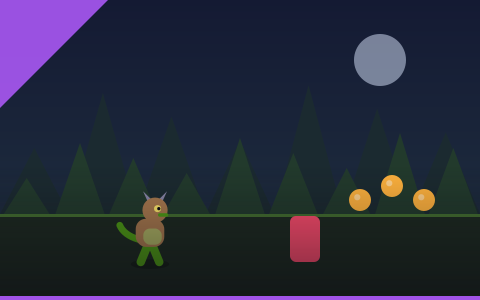
Runner
Monster Dash
Two actions, endless forest, instant restart. The best first game on the site.
Jungle Beast Run takes the endless runner and adds a scoring layer that deliberately disagrees with survival. Fruit hangs on the high line, reachable only by swinging on vines, while the ground route is safe and worth almost nothing. Every few seconds you decide how greedy you are.
Score as highly as possible. Distance contributes, but fruit contributes far more, and fruit chains build a multiplier. Vines let you swing to the high line where the fruit is, at the cost of losing precise control of your landing.
| Action | Keyboard / mouse | Touch |
|---|---|---|
| Jump | Space, W or Up arrow | Jump button |
| Slide | S or Down arrow | Slide button |
| Grab / release vine | Hold Shift or E | Hold the Swing button |
| Pause | P or Esc | Pause button in the top bar |
Pause with P or Esc, restart with R. The game pauses automatically if you switch tabs. Full details in desktop monster game controls and how to use touch controls.
The interesting thing about adding collectibles to a runner is that it breaks the genre's normal clarity. In a pure runner, the correct action is always the safe one. Here, playing purely safe produces a score that is objectively poor — so "correct" becomes a judgement about risk rather than a fact about the obstacle in front of you.
Vines are the mechanic that makes the trade real. Grabbing one launches Fang Sprout into an arc whose endpoint depends on when you release. Release early and you land short, safely, with less fruit. Release late and you clear a longer stretch and collect more, but you land with more horizontal speed and less time to respond to whatever is waiting.
The fruit multiplier caps at ×5 and breaks on any collision, which means a greedy run that ends in a hit is usually worth less than a moderate run that stays clean. We have watched a lot of playtesters learn this the same way: three greedy runs, one cautious run that outscores all of them, and a visible change in strategy afterwards.
The jungle backdrop uses four parallax layers and is the densest scene in the library, which is why this game has a specific reduced-motion mode that flattens the two furthest layers. Dense parallax at speed is genuinely uncomfortable for some people and turning it off should not require turning the game off.
Jungle Beast Run stars Fang Sprout, an original creature created for this site, in a forest setting. Like every monster on Monster Arcade, Fang Sprout is drawn procedurally on canvas from primitives rather than loaded from a sprite sheet — which is why the artwork stays sharp at any screen size and why we can say without qualification that it is our own.
The creatures you face are built from the shared enemy system described in designing monster enemies. Every attack in the library telegraphs before it lands, and the obstacles follow the rules set out in designing monster obstacles. Nothing here borrows from any existing franchise; see our disclaimer for the full statement on originality.
Jungle Beast Run records best score as your personal best. That figure is stored in this browser using localStorage and is never uploaded — there is no server here to upload it to, and no global leaderboard anywhere on the site.
Like every game in the library it uses the shared combo system: consecutive successful actions raise a multiplier, and taking damage or letting the chain time out resets it. How combo systems work explains the mechanic in full, and how scoring systems work covers what each metric actually measures.
Difficulty is rated Medium, which describes execution pressure rather than depth — see monster game difficulty explained for how we set these labels and why the curve is asymptotic rather than linear.
Hold the swing button near a vine to grab it and release to launch. Releasing later gives you a longer arc and more fruit, but you land with more speed and less reaction time.
Partly. A pure ground run scores poorly, but a greedy run that takes a hit usually scores worse than a moderate clean one, because the fruit multiplier resets on any collision.
Yes. The game respects your system's prefers-reduced-motion setting and flattens the two furthest background layers when it is enabled.
Distance plus fruit value multiplied by your current chain. Fruit contributes far more than distance, which is what makes the high line worth the risk.
Chosen by shared category, gameplay type, creature and environment — not at random.
Two actions, endless forest, instant restart. The best first game on the site.

Three lanes across a desert canyon. Obstacles now have a horizontal dimension as well as a vertical one.

You are the monster. Obstacles break instead of blocking — but breaking them still costs you speed.
Fully procedural, no templates, no repeats. The purest reaction test in the library.

Gather treasure in an overgrown clearing while creatures wander through. The clearest combo lesson here.
Find four keys in a shifting forest maze and reach the gate before the Wisp Hounds close in.
Environments
The jungle setting is about layers: a safe ground line and a lucrative high line. How vine swinging works, when to release, and why parallax density is an accessibility question.
Strategy
How to add distance to an endless run: breaking your own rhythm, managing commitment length, deciding how greedy to be with collectibles, and the session-level habits that matter more than any single technique.
Technique
A step-by-step method for reaching a high multiplier and keeping it: the opening, the climb, the plateau, and the specific behaviours that break chains without you noticing.
Browse the monster runner & escape games, the full library of 30 games, or the newest additions. If you are not sure what to try next, let the random picker choose.