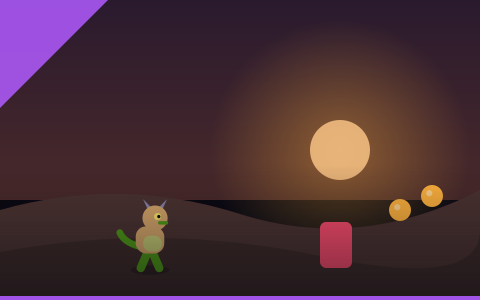
Runner
Beast Run
Three lanes across a desert canyon. Obstacles now have a horizontal dimension as well as a vertical one.
Every other runner on this site has you fleeing something. Giant Monster Rush inverts it: you are the enormous thing, the ruins ahead are in your way rather than the other way round, and most of them will simply break. The catch is that breaking things costs momentum, and momentum is the whole game.
Travel as far as possible. Small obstacles shatter on contact but slow you down; large ones must be leapt or they stop you dead. Your speed is both your score rate and your survival, and it decays constantly unless you are charging.
| Action | Keyboard / mouse | Touch |
|---|---|---|
| Charge | Hold Right arrow or D | Charge button |
| Leap | Space, W or Up arrow | Leap button |
| Stomp | S or Down arrow | Stomp button |
| Pause | P or Esc | Pause button in the top bar |
Pause with P or Esc, restart with R. The game pauses automatically if you switch tabs. Full details in desktop monster game controls and how to use touch controls.
Making the player the monster changes how every obstacle reads. A stone pillar is not a threat, it is a decision: smash through it and lose fifteen per cent of your speed, or leap it and keep everything at the cost of a commitment in the air. Neither is always correct, which is what keeps a very simple game interesting for several minutes at a time.
Speed decays continuously and is restored by charging, which you can only do on the ground. That gives the game a natural rhythm — charge, leap, land, charge — and means a run ends not with a collision but with a gradual grind to a halt after too many smashes in a row. It is one of the few games here where you can watch yourself losing several seconds before it happens.
The Moss Giant's stomp is a small area attack that clears low rubble without the speed penalty of walking into it, but it has a recovery window during which you cannot charge. Using it well means stomping through clustered small obstacles where a smash would cost several penalties, and never using it on a single obstacle you could have simply walked through.
Scale is handled with a pulled-back camera and deliberately small background detail — birds, tiny carts, distant figures — that never interacts with gameplay. It is there entirely to sell the idea that you are enormous, which is most of the appeal. The mechanics would work at any size; the feeling would not.
Giant Monster Rush stars Moss Giant, an original creature created for this site, in a desert setting. Like every monster on Monster Arcade, Moss Giant is drawn procedurally on canvas from primitives rather than loaded from a sprite sheet — which is why the artwork stays sharp at any screen size and why we can say without qualification that it is our own.
The creatures you face are built from the shared enemy system described in designing monster enemies. Every attack in the library telegraphs before it lands, and the obstacles follow the rules set out in designing monster obstacles. Nothing here borrows from any existing franchise; see our disclaimer for the full statement on originality.
Giant Monster Rush records best distance as your personal best. That figure is stored in this browser using localStorage and is never uploaded — there is no server here to upload it to, and no global leaderboard anywhere on the site.
Like every game in the library it uses the shared combo system: consecutive successful actions raise a multiplier, and taking damage or letting the chain time out resets it. How combo systems work explains the mechanic in full, and how scoring systems work covers what each metric actually measures.
Difficulty is rated Easy, which describes execution pressure rather than depth — see monster game difficulty explained for how we set these labels and why the curve is asymptotic rather than linear.
No — you are the monster. The ruins are in your way rather than pursuing you, which makes this the only runner on the site where obstacles are a choice rather than a threat.
Running out of speed, or hitting a large obstacle you should have leapt. Speed decays constantly and is only restored by charging on the ground.
On clusters of small rubble, where smashing each piece would cost several speed penalties. Never on a single obstacle — the recovery window costs more than the smash.
Yes, it is the most forgiving runner here. Most mistakes cost speed rather than ending the run, so a bad patch is recoverable.
Chosen by shared category, gameplay type, creature and environment — not at random.
Three lanes across a desert canyon. Obstacles now have a horizontal dimension as well as a vertical one.
Two actions, endless forest, instant restart. The best first game on the site.
A runner that scores fruit as well as distance, so the safe line and the best line diverge.
Fully procedural, no templates, no repeats. The purest reaction test in the library.

Steer a rolling creature over desert dunes. Momentum is everything and it never stops building.

Collect ice crystals on a frozen lake where you cannot stop and every turn starts two beats early.
Creature types
Playing as the enormous thing inverts every obstacle. How scale is sold, why momentum replaces collision as the failure state, and what changes when obstacles break instead of blocking.
Category deep dive
Runners are the easiest category to start and the hardest to hold. What separates the five here, why every run ends the same way, and the rhythm trap that causes most plateaus.
Strategy
How to add distance to an endless run: breaking your own rhythm, managing commitment length, deciding how greedy to be with collectibles, and the session-level habits that matter more than any single technique.
Browse the monster runner & escape games, the full library of 30 games, or the newest additions. If you are not sure what to try next, let the random picker choose.